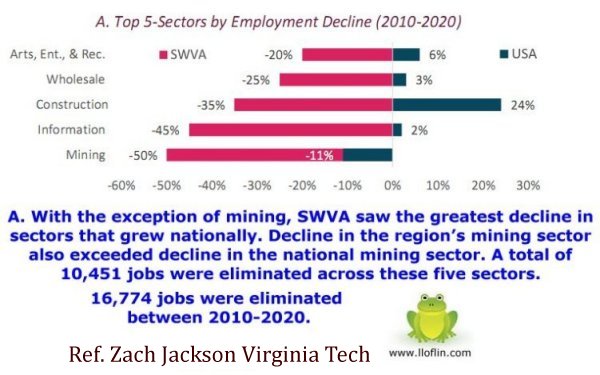
Southwest Virginia Job loses 2010-2020.
Job Horror Story Tri-Cities 2002, 24,000 Jobs Lost
LENOWISCOThe Kingsport Times-News on March 10, 2002 had this to say about the region:
Northeast Tennessee has lost at least 2,100 manufacturing jobs since last July.... At the same time, the region gained 2,200 service-producing jobs... In all, the region posted a net gain of 800 jobs. According to Steb Hipple, economist at East Tennessee State University, "manufacturing jobs tend to pay higher wages and salaries than those in service-related industries. As a result, the region's overall payroll may be declining, despite a net gain of jobs."
- Job Horror Story Tri-Cities 2002, 24,000 Jobs Lost
- Crony Capitalism and more Lousy Call Center Jobs
- How Cable Ready Socialism Failed Southwest Virginia
- Congressman Boucher Brings Home the Bacon in 2009
- Bristol Virginia Utilities Update for 2009, 2019
- Congressman Boucher's Failed Call Center Legacy
- More Replacement Call Center Jobs for Scott County Virginia
- Wise Virginia Call Center Won't Hire 500 New Workers
- Three Decades of Job Losses in Southwest Virginia
Lots of folks are looking for work this Labor Day weekend
KINGSPORT - If you've got a good job, consider yourself fortunate. The Tri-Cities region lost nearly 24,000 jobs from September last year to July this year.
Meanwhile, too many people have been competing for too few jobs. In July, 2,786 people applied for just 441 job openings in the region, while a whopping 38,483 folks were vying for just 5,923 jobs across the state, according to the Tennessee Department of Labor and Workforce Development.
The statistics look pretty bleak for the labor market. "It's the worst labor market in 10 years. I have to go back to the recession of 1991 to see a similar kind of situation,'' said Dan Emmel, director of career placement and internship services at East Tennessee State University.
Mark P. Reineke, commissioner of the Tennessee Department of Labor and Workforce Development, said the Tri-Cities region has been "hit pretty hard" in the last year.
"But I don't think those circumstances or those statistics are necessarily unique to the Tri-Cities metropolitan statistical area,'' Reineke said.
"I think statewide, especially in the manufacturing sector of the marketplace, Tennessee has been hit hard. We have certainly seen an increase in unemployment and layoffs over the past year,'' he said. The Tri-Cities lost a total of 23,700 jobs from September 2001 to July 2002. Some 22,600 of those jobs were in the service-producing sectors, while 1,100 positions were in the goods-producing fields. Emmel said the economic downturn has impacted nearly every industry.
"We've had a lot of companies lay off, we've had a lot of companies close down. Some companies have sold out to other companies. And that's all affected the labor market,'' Emmel said.
He said the biggest difference in jobs today vs. last year is the pay. "The well-paying jobs have really decreased in number. This has been true locally and it's been true nationally,'' Emmel said. Reineke said the Department of Labor is working to improve the state's labor market picture. The department operates 14 career centers across the state that serve as one-stop options for job seekers and employers alike. Through the centers, job seekers can file unemployment claims, get the latest job listings, take job-training courses, and get help to further their education - all free of charge. Meanwhile employers can get help finding employees to fill job openings.
"We connect people with jobs,'' Reineke said. "Primarily our focus at the career centers is to help people find jobs and improve themselves and get whatever education and training they need to reach that end. It really is a full-service job and training resource center."
The nearest career center is located in Johnson City. The career centers have been busy in the last year, helping folks who've lost their jobs due to downsizing, plant closures, or other reasons.
But Reineke said the unemployment picture is beginning to turn around. The number of jobless claims is decreasing across the state, and the number of weeks claimed in unemployment benefits is declining, "which means that people are not staying unemployed as long," he said. "We're even seeing some increases in the manufacturing sector,"
Reineke said.
He cited the new Bush Hog plant in Telford. The plant has hired roughly 170 to 180 people in the past year, and it plans to add another 90 to 100 employees by the end of the year, Reineke said. "So although it has been a difficult year or two, we are certainly seeing some signs of improvement,'' he said. "It has not happened as quickly as some economists expected. But we are getting there. So things are looking up."
Not fast enough for the thousands of folks still facing another week without work. Emmel said most large employers are not doing any "significant" hiring these days. "In fact, some of them are still going through layoffs,'' he said.
Some smaller employers are beginning to fill positions - albeit slowly, Emmel said. "But they're very specific on what they want. And they want the person who has experience. Nowadays they can be quite choosy,'' he said.
For the recent college graduate, the labor market poses greater challenges, Emmel said. "They've not only had to compete with their own peers, which they always have to do. But now they have to compete with a labor force that has a lot of experienced people out there. And it's making it extremely difficult," Emmel said.
He said the labor market picture for the remainder of the year will largely depend on employer confidence. "Right now, most employers are adopting a wait-and-see attitude. Will we go to war with Saddam Hussein? Will the oil prices spike up again? Will we have another terrorist attack? There's a great deal of uncertainty out there. And so many organizations have been affected by this uncertainty,'' Emmel said.
He said the recent announcements of airline cutbacks and bankruptcy filing by US Airways have impacted the economy and employer confidence as well.
"Then the announcement of the Siemens plant (in Johnson City) up for sale. It's things like this that are causing employers to become very cautious,'' Emmel said.
He said employers are replacing people they "absolutely" must replace. Other positions are being left open, while remaining employees shoulder the workload of their departed colleague. "And that's creating some tremendous pressure in the workplace,'' Emmel said. "People are doing more than one person's job. They are stress-filled. And this is causing a lot of issues in the workplace by itself."
Emmel predicted the labor market to be "very volatile, very cyclical" in the next several years. "We will get out of the recession, there's no question about that. But there are a lot of ifs, a lot of stumbling blocks."
He said folks thinking about a career change, might want to consider a field in high demand, such as healthcare. The nation is experiencing a shortage of nurses, and other healthcare positions are in demand as well, such as physical therapy.
Emmel said computer science and the information technology field, particularly information security, are also gaining jobs. And teachers are in demand in various places across the country, particularly teachers of foreign languages. Emmel said his department just received two job listings in Georgia for foreign language teachers.
"But every one of these jobs is very specific. These aren't jobs that you get a degree and drift into. You have to have a specific degree to do a specific job, and that seems to be a direction of the job market here,'' Emmel said.
He said the government is also adding jobs, particularly in security-related positions. But job seekers must be willing to relocate.
"Geographic mobility is a major factor nowadays. To find the opportunities you have to go to other locations,'' he said. "The main thing is: If you have a job - keep it. And if you are going to try to change, be very specific and realistic about your goals. ... Remember the employer is looking at the bottom line and thinking, 'What kind of productivity can I get from this person.' That's driving everything,'' Emmel said.
Copyright August 31, 2002 Kingsport Times-News
Yes we have broadband and spent millions.
Cable Ready Socialism
How CGI-AMS and Northrop Grumman Failed Russell County
How Cable Ready Socialism Failed Southwest Virginia
Sprint Jumps State Line Collects Millions
U.S. Solutions Dumps Bristol Virginia for Bristol Tennessee
Travelocity Fails Dickenson County
To quote LENOWISCO Broadband Study Warned against Call Centers (PDF file):
- Wise Virginia Call Center Won't Hire 500 New Workers
- Tobacco Commission Sykes Fiasco Reveals Government Waste
"The region has been replacing traditional (better paying) manufacturing jobs with (low paying subsidized) call center jobs, which provide limited advancement and work opportunities. Call centers represent the factory floor of the Knowledge Economy; they are an important part of a diversified economic development strategy, but the region must be careful not to rely too heavily on them, as the work is easily moved to other regions and/or other countries."
- Gov. McAuliffe Another Porkbarrel King
- 400 New Jobs is Just 0 Jobs
- Bristol Compressors Closes Cost Taxpayers Millions
- Government Agriculture Grants Pork Barrel Waste
- Bristol Schools to Teach Cannabis Farming?
- ALICE in Poverty Land in Southwest Virginia
- Morgan Griffith, Phil Roe Betray American Workers
- Morgan Griffith Wrong about Volvo Trucks
- Web Master
- Bristol, Southwest Virginia Revealed
- Hobby Electronics
- US Constitution
- Christianity 101
- Religious Themes
- Guestbook Archive
Web site Copyright Lewis Loflin, All rights reserved.
If using this material on another site, please provide a link back to my site.