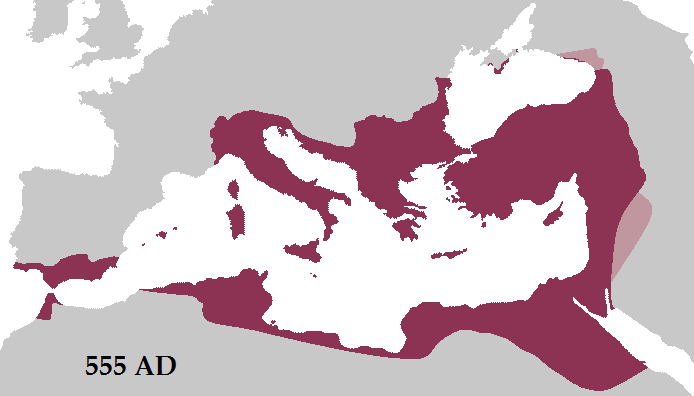
Byzantine Empire 555 AD
Origins of Christianity 101
Exploring Religion Modern and Ancient 2
The material below is presented to the layperson to introduce them to the many currents that operate within Christianity, Gnosticism, Judaism, Zoroastrianism, and Hellenism. Most of the material I use is written by believers in God (myself included) and I try to avoid the use of material from atheist/Humanist' sources.
Broadly in my view Christianity is a Hellenistic philosophy claiming the "authority" of the Holy Spirit, something not found in Old Testament Judaism. See Gospel Roots Christian Pantheism.
Pantheism holds God and Nature as somehow intertwined or dwells within matter. This is a common theme in New Age Religion, Paganism, and environmentalism.
James Lovelock creator of the Gaia Hypothesis has become concerned his ideas and environmentalism in general has "become a religion, and religions don't worry too much about facts.". science in general is being poisoned by inserting religious mysticism and politics into the mix and failing to adhere to the Scientific Method.
- 25 Questions and answers for Creationism
- Why Fundamentalists are Beyond Reason
- How Alarmists Undermine Science and Theology
I have no interest in promoting any particular belief system judging each as an individual based on their actions alone. I'm an equal opportunity skeptic.
While Jesus was human and an object of worship, Paul created what became Christianity as can be seen by reading Galatians when Paul broke from Jesus' Jewish church/sect under his brother James and Judaism in total over circumcision - he rejected and hated Judaism anyway being a Hellenist and influenced by Gnosticism. Paul and his followers wrote most of the New Testament, his epistles predating Matthew, Mark, and Luke by 20 years or more. Mark and Luke were Paul's followers and certainly Luke like Paul never met the earthly Jesus.
For the record I don't believe people can communicate with dead people, ghosts, or spirits. Their claims of "divine revelation" while possible without proof are simply their personal beliefs. Christianity is better called Paulism. Paul bitter that his Gnostic beliefs converted few Jews that with his followers concocted the lie Jews Killed Their Own Prophets which they did no such thing.
- Jesus the Man
- Apostle Paul Founder of Christianity
- Why we should know John Calvin
- Egyptian-Christian Connection
- Judaism Meets Zoroastrianism
- Judaism Meets Hellenism and the Logos
- Pelagius Why He Was Right
- Saint Augustine Introduction
- Saint Augustine His Christian World View by Lewis Loflin
- Criticism of St. Augustine
- St. Augustine and Evolution
- Premillennialism and John Nelson Darby
- Christian Anti-Semitism
- Judaism Meets Hellenism and the Logos
- Hellenism and Its Influences on Judaism in Alexandria
- Resemblances Between Zoroastrianism and Judaism
- Christian Jew-Haters
- Christianity as a sect of Judaism?
- Jews Killed Christ?
- Hellenism Meets Judaism
- Hellenistic Judaism
- Monotheism
- Remembering the Jews of Monticello
- John Adams embraces a Jewish homeland
- Reform Judaism and the relationship to Deism.
- Who is Moses Mendelssohn?
- Christianity 101 Revealed
- Debunking the Khazar Jews Anglo-Saxon Israel Myth
- Why Jews Are Not a Race
- Questions on Christian Anti-Semitism
- Islam's History of Anti-Semitism
- Christian Identity A Religion for White Racists
- Christian Identity Dogma of Hate
- Christian Identity History of Hate, Irrationalism
Christian Origins Hellenism and Gnosticism
After the conquests of Alexander the Great Greek culture was spread across the former Persian Empire. Many embraced a fusion of higher Greek culture with their own while Greek colonists incorporated local gods, religions and cultures into their own culture. Nowhere was this more divisive than among the Jews.
Judah was caught between the endless wars between hostile Greek Syria and a tolerant Greek Egypt. Maccabees 1 & 2 was more about a civil war between Hellenist Jews and Orthodox Jews than freedom from Damascus. That went on even after the time of Jesus.
The vast Jewish communities of Alexandria welcomed Greek ideas and incorporated that into what I'd call Hellenistic Judaism. Philo did just this and some Church Fathers referred to him as the first Christian - he was a contemporary of Paul.
Hellenistic Judaism broadly was more universal, less political, and more "liberal". It certainly was far more spiritual and pantheistic - I'd suggest reading the Apocrypha.
From this Hellenistic stew-pot would arise what became Christianity and its sisters that was considered heresies dumped under the term Gnosticism - they are really the same differing in how the Church defined a single word. Paul claimed salvation by "faith" while Gnosticism claims by divine knowledge - both advocated a spiritual union with the divine. Paul used "faith" and "knowledge" interchangeably.
- Notes on Neoplatonism
- Early Christian and Medieval Neoplatonism
- Pelagius and why he was right.
- Christianity Philo's Synthesis of Judaism and Hellenism
- Gospel Roots Christian Pantheism
- A discussion of Pantheism and Deism
- Overview of Gnosticism
- Gnostic Terms
- Alexander, the Jews, and Hellenism
- Hellenistic period
- Syncretism
- Platonism and Christianity
- Demiurge
- Who are the Cathers?
- Docetism
- Allegorical Interpretation
- Marcion's Church Not Really Gnostic?
- Jewish Origins of Gnosticism
- Original Sin
- Original Sin as seen from Judaism
- Dualism
- John Calvin: Free Will and Predestination
- 3 Magi, Zoroastrian Pilgrims
- Jesus the Man
- Paul the Apostle and Salvation Thru Faith
- James, Paul, Dead Sea Scrolls by John Oller
- Theology of Paul
- Review of Hyam Maccoby's Paul and Hellenism by John Mann
- Paul's Bungling Attempt At Sounding Pharisaic by Hyam Maccoby
- Hyam Maccoby was Mostly Right
- Jesus Acted as a Pharisee
- Jesus, Jewish Resistance, Day of the Lord
- Paul's Companion St. Luke
- Maccoby's Theories Historical Jesus
- Problem of Paul Introduction
- Problem of Paul Part 1
- Problem of Paul Part 2
- Monotheism and the Messiah
- Jesus, Jewish Resistance, Pharisees
- Jesus, Jewish Resistance, King of the Jews
- Apostle Paul Founder of Christianity
- Jesus: Apocalyptic Prophet
- Modern Ebionites
- Comments on the Ebionites
- Comments on the Apostle Paul
- Jesus and The Day of the Lord
- Paul: the Father of Sexism and Anti-Semitism?
- Reassessing the Apostle Paul
- The Heresy of Thomas: Mystery & Wisdom
- James the Just and Salvation via Works
- The Heresy of Peter: Compromised Christianity
- The Heresy of Luther: Reformation Undone
- "Killed Their Own Prophets": New Testament Libel of the Jews
- Jesus the Man
- Paul's Companion St. Luke
- Apostle Paul Founder of Christianity
- Heresy of Thomas Mystery & Wisdom
- James the Just Salvation Through Works
- Heresy of Peter Compromised Christianity
- Heresy of Luther Reformation Undone
- Martin Luther in Summary
- Jews 'Killed Their Own Prophets' Lie
St. Augustine Father of Protestantism
My introduction to St. Augustine was his Confessions I read in college. While my Christian friends found Confessions uplifting I found it appalling. Written after his conversion I was repulsed by his self-loathing and the entire concepts of grace and election that reduced merely being human somehow evil and "salvation" a mere whim of God.
- Saint Augustine Introduction
- Saint Augustine His Christian World View by Lewis Loflin
- Criticism of St. Augustine
- St. Augustine and Evolution
- Early Years of St Augustine
- St Augustine: Development of His Views
- St Augustine: Conversion and Ordination
- St. Augustine: Anti-Manicheanism and Pelagian Writings
- St Augustine: Manichean and Neoplatonist Period
- St. Augustine: Activity Against Donatism
Zoroastrianism
Zoroastrianism was a great monotheistic of ancient Persia today Iran. This in various forms was the Persian state religion very friendly to Judaism in particular with Nehemiah and Ezra book books at one time a single volume. Under Persian rule the Jews returned to Jerusalem at the decree of the Persian King Cyrus. The Jewish Encyclopedia notes the great influence the Persians had on Judaism and Christianity.
- Were the Three Magi Zoroastrian Pilgrims?
- Biblical Monotheism and Persian Influences
- More Questions on Zoroastrianism for Comparison
- Traditional Zoroastrianism Another View
- Early Life of Zoroaster From Zoroastrians
- Calling Jesus a Recreation of Zoroaster is Rubbish
- Zoroastrianism Influence on Christianity and Judaism Hard to Prove
- Zoroastrianism and Judaism According to the Jewish Encyclopedia
- Influence of Zoroastrianism On Judaism, Christianity, Hinduism, Buddhism
- Why Jesus was not Zoroaster or Buddha
- Resemblance Between Zoroastrianism, Judaism Coincidence?
- Hellenism Meets Judaism
- Judaism Versus Zoroastrianism
- What are we to believe?
- Zoroastrians Keep Dwindling
- Under Judaism God Alone Does Good and Evil
- Problem of Original Source Material for Zoroastrianism
- Another Look at Religion in America 2008
- Jesus from a non-Protestant View
- Death and Mayhem in the Old Testament
- Why Liberal Christian Churches are Failures
- Anabaptists: Separate by Choice, Marginal by Force
- Comments from Mark and Don on the End-Times
- Arianism
- Arminianism, an overview
- Calvin and Calvinism
- Comments on the Great Awakening
- Devil, Demons and Hell
- The Devil Did Not Make You Do It
- Jesus the Man
- Marcion
- The Gospel of John, an overview
- Early Christian and Medieval Neoplatonism
- Salvation is not just "faith alone"
- Servetus: His Ashes Cry Out Against John Calvin
- Are Christians Crazy?
- Pelagius: Defense Of The Freedom Of The Will
- Pelagius
Freemasons, Unitarians, Deists
- French Deism: deistic Humanism, Pantheism
- The English Deists: Introduction
- Is it Unitarianism or Deism?
- Fewer Americans in church
- The English Deists: Matthew Tindal
- Why Do Some People Hate Freemasonry? by D. Pipes
- Famous Freemasons
- What is the connection between Judaism and Freemasonry?
- Elizabeth and the Puritans by Will Durant
- The Summons to Reason 1558-1649 by Will Durant
- Rule of Religion by Will Durant
- Sermon: Unitarian Roots in England and America
- Thomas Paine: Apostle of Freedom
- Information on John Locke
- Freemasons, Conspiracy Thinking, and Pat Robertson
- Pat Robertson and More Conspiracy Theories
- Conspiracy theories and Blacks
- The Hard Right and Conspiracy Theories
- A Messianic Bloodline, the Jews and Freemasonry
Evolution
- Which Creation Biblical Story?
- Religion of Isaac Asimov
- Ohio Board Hears Debate on an Alternative to Darwinism
End Times
- What is Christian Fundamentalism?
- Dispensationalism and John Nelson Darby
- Comments From a Former Fundamentalist
- Comments and additions from Mark
- The Adventists Churches and the End-Times
- Armageddon and All That Jazz
- 220 Failed Second Comings
- Pastors Play Down End-Times Speculation
- Christian Confusion and the End-Times
- Comments on the Second Great Awakening
- The gospel roots of Christian pantheism
- The incoming sea of faith
- Sinners in the Hands of an Angry God
- Unitarianism Spreads in the Church of England, 1690 - 1750
- Islam Versus Deism
- Origin of the Koran
- Who served in the US military?
- Israel Storm: a warning from a Hindu
- Saudi Arabia Still Number 1 Terrorist State in 2008
- Lt. Col. Martha McSally wins fight against degrading Islamic garb!
- Muslim 'Palestinians' firebomb Christian 'Palestinians'
- Why Islamism and the Left Hate Daniel Pipes
- Islam's Deadly Truth
- Islamic Bloc, Christian Right Team Up to Lobby U.N.
- At Least 7 Killed as Muslim Terrorists Bomb Jerusalem Campus
- Do I hate Islam and Muslims? It's about Sharia
- UNWORTHY OF TURKEY: Lessons from Iran's Easter parade of British hostages
- Ask Professor Esposito, NOI, and Racism
- Feds hold retired doctor under shrouded circumstances, controversy erupts.
- The Fight for Democracy in Iran and a salute to heroes.
- Congressmen Challenge 'Friendship' of Child-Stealing Saudis
Religious Traditions
- Spiritual Ecology
- New Age Religion
- Christian Trinity
- Gnosticism
- Jesus the Man
- Pelagius was Right
- Apostle Paul
- Original Sin
- Christianity
- Deism
- Article lists:
- Religion 1
- Religion 2
- Religion 3
- Religion 4
- Religion 5
- Religion 6
- Religion 7
Web site Copyright Lewis Loflin, All rights reserved.
If using this material on another site, please provide a link back to my site.