Taking a Sober View on Climate Change
Also see Exploring Religion and Environmentalism
What does Al Gore say about the 'science' behind so-called climate change?
"As it happens, the idea of social justice is inextricably linked in the Scriptures with ecology."
So here is the view of this website in no uncertain terms - climate change is real and it's a normal part of the earth's process. That change has always existed and is the driving force behind evolution. It's all through the historical record and is beyond dispute.
The record cold of 2014 has thrown more doubt on this issues and I'll debunk three claims right off the bat:
Hurricane Sandy was the worse on record - caused by climate change many were claiming.
Nonsense on both counts. Hurricane Sandy just wasn't that bad compared to the earlier 1938 New England hurricane. Sandy only killed 117 people - if we include heart attacks and auto accidents as far away as West Virginia.
The New England Hurricane of 1938 (or Great New England Hurricane, Yankee Clipper, Long Island Express, or simply the Great Hurricane) was the first major hurricane to strike New England since 1869. The storm formed near the coast of Africa in September of the 1938 Atlantic hurricane season, becoming a Category 5 hurricane on the Saffir-Simpson Hurricane Scale before making landfall as a Category 3 hurricane on Long Island on September 21.
The hurricane was estimated to have killed between 682 and 800 people, damaged or destroyed over 57,000 homes, and caused property losses estimated at US$306 million ($4.7 billion in 2013). Even as late as 1951, damaged trees and buildings were still seen in the affected areas. It remains the most powerful, costliest and deadliest hurricane in recent New England history, eclipsed in landfall intensity perhaps only by the Great Colonial Hurricane of 1635. (wiki)
Recent violent tornadoes sign of climate change.
Wrong again, climate change is normal anyway. While tornadoes killed 158 in Joplin, Mo. and another least 24 lives in Moore, Okla. they were nothing compared to the Tri-State Tornado March 18, 1925:
The Great Tri-State Tornado of Wednesday, March 18, 1925, is the deadliest tornado in U.S. history. Inflicting 695 fatalities, the tornado killed more than twice as many as the second deadliest, the 1840 Great Natchez Tornado. The continuous over 219 mile track left by the tornado was the longest ever recorded in the world as it crossed from southeastern Missouri, through southern Illinois, then into southwestern Indiana. Although not officially rated by NOAA, it is recognized by most experts as an F5 tornado.
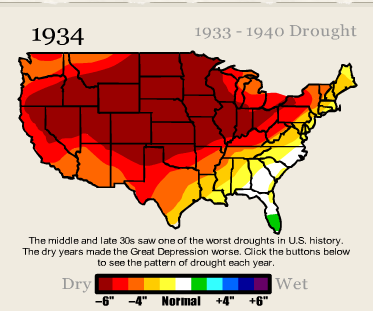
But climate change is causing droughts...
Really? What about the fact droughts run in cycles with the worse being in the 1930s?
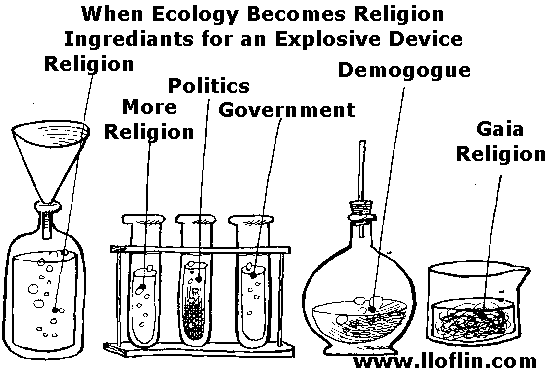
I'm not skeptical of climate change, but I'm skeptical of the people involved in the issue such as Al Gore. I don't care about the religious or spiritual views of others towards nature, but don't impose it on me and keep this nonsense out of politics. Human welfare trumps nature.
Does human activity impact climate? I say perhaps yes, but not to the degree climate alarmists claim at present. There is simply no way to separate human activity from natural variation. And yes there is natural variation.
Is this good or bad for the earth? First of all people come first, not the earth as many environmentalists seem to advocate. The "earth" is in no manner a being or organism as James Lovelock seems to suggest and Gaia is simply a myth. The real question is how does natural variation combined with human influences effect the overall picture?
Let me be clear in that the endless spewing of gasses into the atmosphere must be curtailed, but in a reasonable way with new technology and not using the issue to re-engineer society along desired political lines.
If human activity causes warming, but this mitigates global cooling, that is a good thing. Global cooling through human history has contributed to the fall of the Roman Empire, upset agriculture in the Middle Ages (Little Ice Age) leading to famine, war, etc. This followed the massive warming period (900-1300 AD) that allowed the European/Asian populations to recover from the ravages of Justinian's Plague, etc.
Extra carbon dioxide enhances plant growth, which is a good thing. What is wrong with the frost line moving north opening up millions of acres to agriculture?
Then there are other unpredictable factors such as volcanic eruptions that can play havoc on climate sometimes lasting years or decades. In one case we have Laki, Iceland in 1883. To quote,
The Laki eruption lasted eight months ... Haze from the eruption was reported from Iceland to Syria. In Iceland, the haze lead to the loss of most of the island's livestock (by eating fluorine contaminated grass), crop failure (by acid rain), and the death of one-quarter of the human residents (by famine). Ben Franklin noted the atmospheric effects of the eruption (Wood, 1992). It is estimated that 80 million tons of sulfuric acid aerosol was released by the eruption (4 times more than El Chichon and 80 times more than Mount St. Helens).
The climatic effects of the Laki eruption are impressive. In the eastern United States, the winter average temperature was 4.8 degrees C below the 225 year average. The estimate for the temperature decrease of the entire Northern Hemisphere is about 1 degree C.
Another massive eruption was Mount Tambora in 1815 in Indonesia:
With an estimated ejecta volume of 160 km3 (38 cubic miles), Tambora's 1815 outburst was the largest volcanic eruption in recorded history. The explosion was heard on Sumatra island more than 2,000 km (1,200 mi) away....
The eruption caused global climate anomalies that included the phenomenon known as "volcanic winter": 1816 became known as the "Year Without a Summer" because of the effect on North American and European weather. Agricultural crops failed and livestock died in much of the Northern Hemisphere, resulting in the worst famine of the 19th century.
What if we have the eruption of the super volcano that some scientists predict someday for Yellowstone National Park? Geological studies of the Permian Extinction 250 million years ago is believed to have been caused by the eruptions in modern Siberia (Siberian Trapps) covering an area the size of the US in several feet of basalt.
The ash and poison gasses such as sulfur dioxide would have triggered massive global cooling, while the massive amounts of carbon dioxide released later raised global temperatures.
The rise in global temperatures may also have triggered an out-gassing or melting of methane hydrate (ice) from the ocean floor. Methane as a "greenhouse" gas is 20 times more potent than carbon dioxide. These together they may have raised global temperatures to over 20 degrees Fahrenheit.
This killed 95 percent of all life including marine organisms and even insects changing the direction of evolution.
Could the wrong combination of human and natural factors trigger this kind of chain reaction? It's certainly possible, but not likely.
There are many other natural phenomena that simply can't be predicted. Cosmic rays striking the atmosphere create aerosols which with clouds reflect sunlight and cause cooling. (Nature, Cloud formation may be linked to cosmic rays, August 24, 2011.) This is under dispute as is the fact solar radiation has increased since the 1970s. What effect do these factors play when combined with human activity?
My point is there's so many things going on that collectively could mean anything good or bad. Science has become too politicized and too busy chasing government money. We have every right to be skeptical, but to treat honest skepticism and demands for proof as some form of religious heresy is crossing the line. Scientists shouldn't be allowed to become a type of priestly caste all their own dependant on political largess to support themselves.
Should we get away from fossil fuels and use alternative energy? Absolutely yes! I dislike coal and oil production myself, but other than nuclear we have no real alternatives. I also have a big problem with nuclear waste, which is not a technical problem, but a political problem compounded by corporate greed.
The almost 80,000 tons of spent fuel robs simply sitting around nuclear power plants have to cooled in ponds of water or else could catch fire spewing radiation over a large area. They could be re-processed into new rods eliminating 90 percent or more of the material. The remaining "waste" can be diluted/fused/dissolved into/with scrap glass and buried. The power companies simply don't want to pay the costs and environmental activists are simply irrational on the issue.
Why not go check out the recent studies on how wildlife is flourishing in many areas surrounding Chernobyl? Why not check out the flourishing wildlife at Bikini Atoll that saw the testing of over 30 nuclear detonations in the 1940s-1950s? What about Hiroshima and Nagasaki that are both totally rebuilt and nobody would even know of any nuclear detonations outside the memorials? It's time for reason, not unfounded ignorance and hysteria.
This should not be taken lightly and I have no desire to underplay these problems, but at the same time hysteria solves nothing. Poverty causes more damage to the environment than does affluence.
Windmills and solar panels as much as I like them are not practical on a large scale. They are very energy intensive to manufacture the silicon and the powerful, light-weight magnets in the windmills (and electric cars, etc.) have to use fairly rare metals such as niobium to be practical.
How many millions of acres of forest do we cut down to install these things (at least east of the Mississippi) and their transmission lines? How much wilderness do we destroy to grow government subsidized biomass crops just to make low grade motor fuel? Is it really a good idea to destroy food crops for ethanol grown with fossil fuels?
Nonsense such as "environmental justice" and attempts to redistribute wealth via international taxes and regulation is just more rehashed Marxism and is to be rejected outright. Attempts at giving the earth or nature "rights" is simply religious nonsense and has no place in politics or science. We must stop tying the award of research grants to desired outcomes.
I hope that makes my position clear. I live in a rural area and do a lot to keep my local environment clean and take great care to guard the animals and plants on my small piece of the earth. At the same time I do not worship it nor will I allow people living in urban America tell me how to live my life or what to do with my property. If they are so damned determined to "protect" nature, then I suggest they live like the Amish people or shut up.
Religious Articles Index
Origins Christianity


- Environmentalism 50 Years of Observation
- Government Study on Climate Change Raises Questions
- Paradise California Fire Ignore Natural Causes
- Ecology as Environmental Socialism
- Peripheral Virginia Versus Climate Change Activism
- Nature's End? Crackpots Get It Wrong Again
- Our Obsession with Armageddon, Some Welcome It
- Science Ignorance Doomed Biosphere 2
- Common Sense Environmentalism
- Spiritual Ecology Versus Science
- Green Religion Won't Save Appalachia
- How Ecological Homeostasis and Hysteresis Regulate Climate
- Ages of Gaia Writer James Lovelock Sounds an Alarm
- Writer James Lovelock Backtracks on Revenge of Gaia
- How Bacteria Created Natural Nuclear Fission
- Michael Crichton Speech - Environmentalism as Religion
- Environmentalism as Religion by Michael Fumento
- Environmentalism's Fear-Loathing of Technology
- Shockingly Rapid Climatic Shifts are Real
- Hypsithermal Warming Spreads Civilization 6000-9000 BC
- Dr. James Hansen Paid Environmentalist
- NASA Scientist Demands Prosecution Climate Change Critics
- Dissecting Al Gore's Book Earth in the Balance
- Second Great Awakening An Overview
- Critical Review Regressive Liberalism
- Address Corporate Culture Before Handing Out Money
- Postmodernism Attacks Reason, Science, and Culture
- Off Site:
- Web Master
- Tri-Cities VA-TN
- General Science
- Hobby Electronics
- US Constitution
- Christianity 101
- Religious Themes
Web site Copyright Lewis Loflin, All rights reserved.
If using this material on another site, please provide a link back to my site.