Four People Nailed for Crack Cocaine, Guns in Bristol, Virginia
by Washington County Virginia Sheriffs Dept.
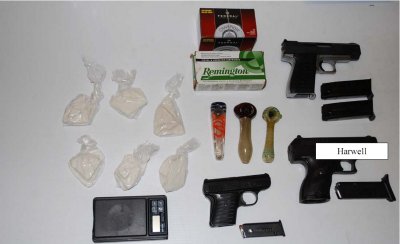
November 24, 2011: An early morning search warrant, executed at a residence in Washington County, VA, has resulted in the seizure of approximately quarter-pound of crack cocaine, three weapons and the arrest of three individuals and warrants being obtained on a fourth person. According to Washington County Sheriff Fred Newman, the search warrant was executed at a residence at 9157 Nininger Road, Bristol, VA, at approximately 6:00 am Wednesday morning.
Phillip Dorne Williams, Jr., age 34, of 22320 Benhams Road, Bristol, VA, has been charged with possession of cocaine. He is currently being held in the Southwest Virginia Regional Jail in Abingdon on a $7,500 secured bond.
Angela Theresa Lee, age 37, of 701 Pennsylvania Avenue, Bristol, TN, was arrested and charged with possession of cocaine. She has been released from the Southwest Virginia Regional Jail in Abingdon on a $3,000 secured bond.
Robin Rhena Harwell, age 36, of 1875 Lee Highway, Apt. 25, Bristol, VA., was arrested and has been charged with possession of cocaine. She is currently being held in the Southwest Virginia Regional Jail in Abingdon on a $3,500 secured bond.
A court date for all three is scheduled for Feb. 15, 2012, in the Washington County General District Court in Abingdon, VA.
Warrants have been obtained for Judy Ellen Garland, age 57, of 9157 Nininger Road, Bristol, VA, charging her with possession of cocaine. She is also wanted on outstanding warrants from Bristol TN. Anyone having information as to her whereabouts is asked to contact the Washington County Virginia Sheriff's Office at 276-676-6000.
Agencies assisting the Washington County Virginia Sheriff's Office in the drug bust include the Abingdon Police Department, Bristol VA Police Department, and the Virginia State Police.

- Murdering Mother The Hidden Face of Honor Killing
- Twenty-Year Plan Islam Targets America
- Who is an Arab Jew? Albert Memmi
- Not Islam - Sufism the Deviated Muslim Path
- America Did Nothing for Israel in 1948
- Islamists Murder Dozens in Bombay India
- Islam Versus Deism
- When Humanism Becomes Fundamentalism
- Deist Examination of Islamic Trinity
- Mohammed the Man as Islamic Ideology
- Why Muslims Can't Build a Lightbulb
- Bacon is not a Hate Crime
- Press Tries to Cover Up Muslim Violence
- Fear of Islam Not Islamophobia
- Islam Versus Deism
- Europeans as Victims of (Muslim) Colonialism
- The Historical Reality of the Muslim Conquests
- Dangers of Political Islam by Lewis Loflin
- Are Judaism and Christianity as Violent as Islam?
- Judeo-Christian Violence vs. Islamic Violence
