Looking back at the waste of Virginia Tobacco Funds
by Lewis Loflin
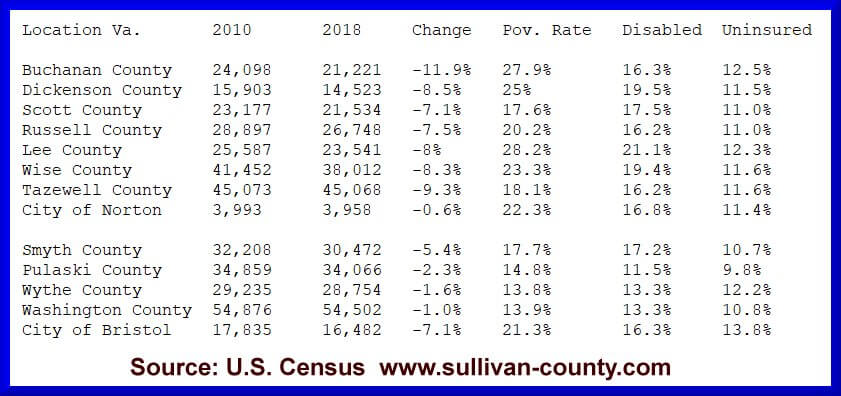
As incredible as it may seem the local press believes the nonsense invested below was a great idea in 2004. Sad to say in 2011 nothing has come of any of this. The recent census shows the region is still losing population and the poverty rate has grown or remained flat.
December 06, 2004 Kingsport Times-News
Tennessee, like most states, has long since seen its tobacco settlement monies go up in smoke.
Not so in Virginia.
Three years ago while Tennessee lawmakers were seizing three years' worth of tobacco settlement monies as a stopgap way to plug the state's chronic budget deficit, Virginia lawmakers thoughtfully targeted that state's share of the multi-year, multibillion dollar fund in a variety of innovative ways. Since, the effect of those two widely differing responses to the tobacco settlement has come back to haunt Northeast Tennessee and help Southwest Virginia.
The latest proof of the soundness of that decision lies in a round of recent grant announcements from the Virginia Tobacco Commission, which targets projects as diverse as expanding hair sheep production and marketing to helping fund the second phase of the Ralph Stanley Museum.
The funds, allocated by the Southwest Virginia Economic Development Committee, will be administered in the 2005 fiscal year and total more than $1 million.
Officials with the town of Clintwood, for example, received a $61,000 grant that will assist with phase two completion of the Dr. Ralph Stanley Museum and Traditional Mountain Music Center.
The center, located along the state-designated Crooked Road Heritage Music Trail that stretches from Dickenson County to Galax, held its grand opening this fall and features hundreds of exhibits highlighting the career of the Grammy Award winner and his brother, Carter.
The additional funding will be combined with a grant of almost $140,000 awarded to the town in May for phase two construction.
Update: Wrong. The Ralph Stanley is a failure and had to be taken over by the Town of Clintwood and has to be bailed out again. See Ralph Stanley Museum Fiasco.
Another recipient of the tobacco fund is Appalachian Sustainable Development, an organization helping farmers who grow organic crops, which got $75,000 for a value-added economic development initiative.
Update: Appalachian Sustainable Development has failed and only survived on government grants. See Sustainable Woods wood-processing facility in Castlewood not sustainable
Other recipients include the University of Virginia's College at Wise, which will receive $50,000 to help with its Entrepreneurial Development Program (Pure pork, nothing came of it.);
the Barter Theatre Foundation, which received $75,000 for infrastructure and site development for the Stonewall Square project (Wasted. See Naked;
the Birthplace of Country Music Alliance, $125,544 for the BCMA Cultural Heritage Center (still not completed as of 2011);
Lee County and Lee County Industrial Development Authority, $40,000 for improvements at the Lee County Airport and $200,000 for expansion efforts at the Constitutional Oaks Industrial Park;
Dante Lives On in Russell County, $21,000 toward the construction of the Dante Coal Mining and Railroad Museum (Wasted. Nothing to show in 2011.);
Damascus, $72,000 for phase one of an engineering and marketing plan for the Creeper Trail Campground on Beaver Dam Creek (Wasted. Nothing to show in 2011.);
Lonesome Pine Arts and Crafts, $105,000 for upgrades at the outdoor drama "Trail of the Lonesome Pine" (Wasted. Nothing to show in 2011.);
the Scott County Economic Development Authority, $15,000 for its Leadership Academy Southwest program (Wasted. Nothing to show in 2011.);
and the Scott County Hair Sheep Association, $50,000 for expanding hair sheep education, production and marketing (Wasted. Nothing to show in 2011.).
These projects are merely the latest of numerous economic development projects Virginia's share of tobacco settlement monies have helped make possible. Another recent example is the expansion of Joy Mining Manufacturing. Yet another example is the so-called "e-58'' plan, which is using tobacco monies to fund fiber-optic links in rural communities.
Project by project, lawmakers' foresight in using tobacco monies is making significant contributions to the economic development of Southwest Virginia.
These funds are helping improve the quality of life by bringing high-paying jobs to an area which can certainly use them.
Virginia lawmakers are to be commended for their forward-thinking strategy of investment that has proven itself many times over, one that promises to benefit the region, as well as the state in general.
- Food City Gets $6 Million Corporate Welfare
- Istobal USA Moves to Bristol Virginia
- Millions in Public Money for WireTough Cylinders
- Bristol Compressors Cuts Another 250 Jobs
- $2 Million for Illegal Funding Virginia Intermont College
- Welfare - Not Just Poor People
- Bristol Tennessee job fair 2012
- Smith County Loses Another 300 Jobs
- A Look at the Corporate Progressive Alliance
- Poor People in Virginia and Tennessee are White
- A Suggestion for Reform in Southwest Virginia Won't Happen
- How "Closed Session" Betrays the Public Trust
- Exide Dumps Bristol Workers after Receiving $34 million in Stimulus Funds
- Sprint Dumps Bristol Virginia for Bristol Tennessee
- Crony Capitalism Times Three Comes to Wise County
- Healing Hands Health Center Gets $10,000 Grant from AT&T
- Barter Theatre Money Woes Exposes Tourism Hype
- Barter Theatre Panics Over Cuts in Government Largess 2011

Lewis Loflin
Follow @Lewis90068157


- Updated 2023
- Web Master
- Bristol, Southwest Virginia Revealed
- Robbery Suspects Run Down Washington County Tennessee Deputy
- Black Male Opens Fire at Kingsport Waffle House
- Crime by Race in Tennessee
- Crime and Violence on Indian Reservations
Web site Copyright Lewis Loflin, All rights reserved.
If using this material on another site, please provide a link back to my site.