30 Years of Government Failure in Southwest Virginia
by Lewis Loflin
TweetDate: March 30, 2017 the Bristol Herald Courier is reporting a blowup between Virginia Gov. Terry McAuliffe and local Republican politicians. This whirls around transferring $500,000 from an economic development agency called VCEDA to another pseudo-government agency known as LENOWISCO. The idea is to start some redundant effort to recruit international business to the depressed coalfields of Virginia. Both of these agencies have wasted tens of millions of dollars in grants and have produced little of value to working people over the last 30 years.
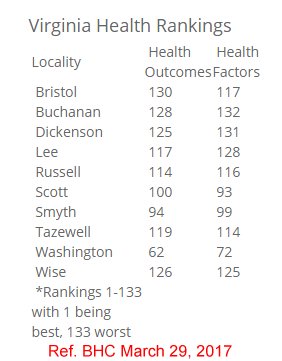
Proof of that failure appeared in a neighboring headline on the same page. The Robert Wood Johnson Foundation in association with the University of Wisconsin Population Health Institute has revealed the coalfield counties of Wise, Buchanan, Russell, Tazewell, Dickinson, the city of Norton, and even Bristol Virginia rank near dead last in Virginia's health rankings. How could communities where these very politicians and agencies, in combination with the Appalachian Regional Commission, and the Virginia Tobacco Commission spend hundreds of millions and produce such disastrous outcomes?
Of the 133 counties and cities of Virginia much of our community ranks in the bottom 10%. Based on a higher number equates to lower outcome, Buchanan County ranked at 128, Dickinson County at 125, Tazewell County at 119, and Lee County at 117. Bristol Virginia ranked at a horrifying 130 just below Martinsville, Petersburg, and Emporia.
Wise County Virginia is an interesting starting point ranked at 126. In a series of articles produced by the Columbus Dispatch in 1999 their studies show the vast majority of money from the Appalachian Regional Commission goes mainly to affluent communities outside of what most people consider Appalachia.
As of that time the 10 communities with the most ARC grant money included Wise County Virginia at $52 million. Since that time to 2017 Wise County has easily received between another $100 million-$200 million in assorted grants. ARC grants are often bundled in combination with VCEDA grants, LENOWISCO grants, and Tobacco Commission grants and other Virginia State grants. $30 million alone was used to build a convocation center at the local college and $13 million in ARC and Tobacco grants to fix up the old Wise Inn. Perhaps another $10 million was spent on an energy research center similar to the failed facility in Bristol Virginia.
Most of the loot ends up being funneled to the University of Virginia campus at Wise into the pockets of college professors, nonprofits, consultants, and economic developers. This is a lucrative jobs program for well-connected degreed professionals and political cronies completely bypassing the average citizen. Despite millions in grants being poured into the community Wise County is worse off today than ever. The complete inability to engineer an economic replacement for the coal industry has left the entire community sitting duck to continuing economic chaos. This is true across the region.
Census figures show that while all of this was going on from April 1, 2010 to July 1, 2016 shows Wise County's population fell by 5.4%. Buchanan County fell 8.0%; Dickenson County fell 5.8%; Russell County fell 5.3%; Scott County fell 5.4%; Wythe County fell 0.7%; Lee County fell 5.5%; even affluent Washington County Virginia fell by 1.2%. Contrast this with neighboring Sullivan County, Tennessee population gained 5.0% and they aren't showered with LENOWISCO, VCEDA, Tobacco, and ARC grants. What's the problem? Where's the accountability?
Yet Scott County, Washington County, and Bristol Virginia all border Sullivan County, so what's going on? It's a problem I've documented for years I call social apartheid. Most of the money and government control flows through a small class of rich and powerful politicians. It's not that our politicians are evil or even corrupt, it's the whole rotten political system that nobody will address. Pouring hundreds of millions of public dollars into the system will virtually guarantee nothing is ever accomplished.
Most disheartening is Russell County Virginia. About 11 years ago Northrop Grumman and AMI–CGS moved into Lebanon Virginia and promised 1000 high-paying tech jobs. Millions in public-funded fiber optic, $2 billion state contract, and a $9 million local incentive package doesn't seem to have paid off. There's no evidence of substantial IT employment in Russell County.
In fairness to the community while still job poor the area has had a vast improvement in appearance. Many of the main towns don't look nearly so run down and a lot of nice new homes have been built in some areas.
While wage scales and employment figures for IT jobs in Russell County are suppressed, the overall lack of jobs, healthcare and demographic collapse, have shown these job and pay claims to be false. My own investigation has shown that the $50,000 a year jobs we were promised were more like $25,000 and the number was far below what was promised. Most of the jobs were not actually IT jobs, but $9 an hour call center jobs. They were paying less than the nearby At&T union call center facility. The Bristol Herald Courier itself did an investigation a few years ago and their conclusions were identical to mine.
According to a 2009 study by the Virginia Economic Bridge Russell County had a TOTAL of 504 IT jobs including the private sector call center, so those jobs are split between the two. Median Income (2007): $59,575 Virginia. $33,682 Russell County. It's $35,045 in 2016.
Buchanan County Virginia was another catastrophic failure of government economic engineering. Between $250-$300 million were spent in the town of Grundy, a community of about 1000, has hardly slowed the demographic and economic collapse of community. Once again efforts at government engineering an alternate economy has fallen flat on its face. How many more times are we going to try something that never works?
New roads, a massive flood control project, and relocating much of the town to a giant strip mine, yielded a single Walmart and some retail. They even built a parking garage at taxpayer expense for the Walmart! A small law school and small pharmacy school paid for and subsidized by a continuous stream of grant money and a call center at the County airport does help some.
New controversy has erupted over President Donald Trump's plan to eliminate ARC funding. Screams and howls of protest from the local press and the grant farming industry filled the headlines. Yet nobody will discuss decades of failure and lack of accountability. ARC grants are heavily politicized because they flow through the hands of the state government or in the case of Virginia Gov. Terry McAuliffe. Virginia in general has a culture of corruption extending to both political parties. Most of the money flowed into the pockets of nonprofits, consultants, economic planners, and friends of local politicians and corporate welfare and a plethora of economic planning commissions.
The Bristol Herald Courier opinion page on March 20, 2017 went into a rant titled "Trump ignored Appalachia" over cutting funding for the Appalachian Regional Commission. The article was very deceptive and dishonest on the number of levels. They claim the ARC has spent more than $4 billion on Appalachia, claims a leverage of $16 billion in private funding. The only problem is of the 410 counties listed by the ARC most have nothing to do with Appalachia. Spartanburg South Carolina, Knoxville Tennessee, Pittsburgh Pennsylvania, New York State, quarter of Mississippi, a half of Alabama, etc. are not in Appalachia.
The Herald Courier claimed the number of high poverty (distressed) counties has been cut from 295 to 90. Yet the Associated Press on May 23, 2004 reported that the ARC had spent $10 billion over 40 years and "the number of counties in the region that are considered 'distressed' have been reduced from 223 to 91 since 1965." Then why if only 223 counties were "distressed" do we have 410 counties? Now we have 295 down to 90 in 2017? Which is it?
In other words the ARC has accomplished nothing in the last 13 years on the core poverty rates in Appalachia. To further quote the 2004 article, "...only eight of the 410 counties in Appalachia are equal to or better than the national average on indicators such as per-capita income, poverty and unemployment rates." Since then many of the non-Appalachian counties may have done better, but the real Appalachia is worse off than ever.
But the recent claim of 90 "distressed" counties is bogus. How can we have so little to show for millions spent in Southwest Virginia? The Bristol Herald Courier gives us a clue. Here is a list of the great programs the ARC is paying for:
$2.2 million to Mountain Empire community college to train students to fly drones. This is a another job for college professors because there's no jobs available in Wise County flying drones. Like the Northrop Grumman fiasco in Lebanon Virginia they are still convinced they can create a technology industry in an area totally unsuited for it. They refuse to address the low pay and abusive business culture that is unattractive to competent and skilled workers. Simply recruiting a company into the area promising low pay scales and generous government handouts has seldom worked in the past.
$1.4 million to start a bunch of cyber security programs at the University of Virginia's College at Wise and Mountain Empire community college and Southwest Virginia community college. This is identical to the programs they ran initially to produce workers for Northrop-Grumman fiasco in Lebanon. There is no evidence of any substantial IT employment in Russell County or in Wise County. This once again is trying to create a technology industry in a low-paying isolated region. Good IT workers will not move to a coal mining county and take a 60% pay cut.
Studies produced by the now defunct Virginia Economic Bridge revealed the typical IT job in Southwest Virginia pays less than half the state average. Let's have no more excuses about stringing fiber optic all over the coalfields. It's already there and has been available in most areas for several years and has produced no real economic development. It's simply become another utility. These are more college professor jobs for those with already high paying jobs.
$1.3 million to the Southwest Virginia Alliance For Manufacturing. This has been around for years and in my opinion is a total ripoff. They supposedly advise companies how to retool for manufacturing from the coal industry to something else. These type of organizations have been around for at least 15 years in one form or the other and have produced nothing that anybody will share with the public. This is a jobs program for nonprofits.
$1.3 million to Mountain Empire community college to retrain out of work miners for jobs as utility lineman. But local community colleges already teach electricity, refrigeration, and other related trades so why do they need extra money to teach somebody to be lineman? The jury is out on this one. This is one of the few programs that might actually translate to some jobs other than college professor jobs. That is if Appalachian Power is actually hiring (presently they are not) or likely they can leave the region to find a job.
$800,000 to something called Virginia Community Capital in Christiansburg Virginia. They operate as a pseudo-banking system to shuffle funds to questionable development projects that legitimate banks are not allowed to meddle with. We have tried this in the past and in my opinion this is just another slush fund.
The Bristol Herald Courier goes on to say, "These seem like the sort of things the federal government should be doing to help build a new economy in Appalachia. That's not exactly making Appalachia great again." Perhaps they could go out and do some actual research and stop printing daily hit pieces on President Trump.
It's time they start taking a critical eye to what really goes on here and the problems that plague the integrity of local government as opposed to cheerleading actions. It's time they started investigating where the money is really going. The Bristol Herald Courier once did hold local government accountable and held to high journalistic standards in defending the public interest, but since falling into the clutches of Media General and now Berkshire Hathaway this is a fading memory.
The census data and the horrific health statistics in Southwest Virginia provides indisputable proof that the hundreds of millions of dollars spent over the past decades has failed. The reason that Donald Trump supporters are so disdainful of government programs that the elite believe we need is because we get absolutely no benefit from them and many liberals most of them well-meaning don't know the truth because the press is failing to do its job. The statistics speak for themselves. Perhaps the Bristol Herald Courier could stop ignoring Appalachia outside their Bristol office.
See
Bristol Virginia Region Exposed 2017
Growing Poverty Job Losses Tri-Cities VA-TN 2016
Growing Poverty Job Losses Tri-Cities VA-TN 2015
- Why the Poor are a Goldmine
- Employment figures mask real truth 2004
- Some still fighting War on Poverty after 40 years
- Critics of the Appalachian Regional Commission say many distressed areas left
- Corporate welfare and Red Lobster for Bristol VA
- Less Welfare, Same Poverty in Heart of Appalachia
- Worlds Apart by Cynthia Duncan
- A Future Imperiled by Poverty
- How the ARC Wastes Millions
- Who Really Gets ARC Mountain Money?
- Poverty Myths
- War on Poverty and how the Poor Lost
The refusal to pay better wages limits the labor pool. We have plenty of college graduates, but that isn't what they want. They desire better educated minimum wage workers to work all of the $6 an hour jobs this region produces. They won't get it. See the following:
- It's not the workers, but the wages: My response in the press
- Businesses want job candidates already trained and ready for work.
- Survey: Region at risk due to critical skills gap Bunk
Quoting a Sullivan County official, he confirmed again what most in power here will not address: "I was in no way casting dispersions on the level of education at ETSU. When I said that "we have ETSU students flipping burgers," I was pointing out that we do not have the level of jobs in this area to sustain the number of graduates from our local colleges. Therefore, they are forced to either leave the area or take what jobs are available to them, which in most cases are in the service area," The trouble is there are no decent jobs even in trades as the Tarnoff report revealed. See:
