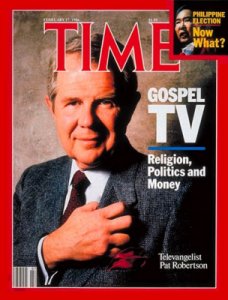
Coalition's Woe's May Hinder Goals of Christian Right
New York Times, August 2, 1999
By Laurie Goodstein
The Christian Coalition, which for 10 years has led the charge of the
religious right in national and local politics, is now weathering serious
financial and leadership turmoil that could affect its ability to exert
widespread influence in the 2000 election, current and former staff members
say.
The coalition is hobbled by a $2.5 million debt, the departure of most of
its experienced leaders, and so much turnover in local leadership that it
currently has strong affiliates in no more than seven states, down from the
48 it claimed last year, the staff members say.
And now even its prior assertions to such widespread strength are in doubt.
Former national leaders who have recently left the group said in interviews
that the coalition, as critics have long suspected, never commanded the
numbers it claimed, and the former leaders revealed some of the techniques
that they said were used to inflate the coalition's power and reach.
The coalition, these former leaders say, distorted the size of its base by
keeping thousands of dead people, wrong addresses and duplicates on its list
of supporters; printed millions of voter guides that the coalition leaders
expected would never be distributed, and hired temporary workers to look
busy in the mail room and phone banks to impress reporters and camera crews.
During some news media tours of coalition headquarters, in Chesapeake, Va.,
former staff members say, a roving group of employees leapfrogged ahead of
the reporters to fill empty offices and telephones.
Despite the coalition's setbacks, Roberta Combs, its new executive vice
president of field operations, and a spokesman, Mike Russell, sounded
optimistic in an interview on Friday, saying that they have started a
campaign to hire directors for all 50 states by the election in 2000. They
would not discuss the group's finances.
"I would say we've lost some momentum," Russell said. "But the
grass roots
of the organization are still there. It's just a question now of getting
back out and re-energizing the existing network."
The coalition now claims 1.8 million to 2 million supporters, but its list
includes many one-time donors, bad addresses and people who once signed a
petition or called an 800 number, former and current staff members say. They
could identify only seven states where the coalition still has an
organization strong enough to affect upcoming elections: South Carolina,
Georgia, Florida, Texas, Massachusetts, Oklahoma and Washington.
"If they can reorganize, it certainly won't be in time at a national level
for the 2000 election," said Charles H. Cunningham, who resigned in March
as
the coalition's director of national operations and is now Capitol Hill
lobbyist for the National Rifle Association.
The Christian Coalition was ranked the seventh most powerful lobbying group
by Fortune magazine last year. But even if it stumbles -- and its leaders
insist they are turning things around -- the religious right as a force in
politics is not likely to disappear.
The coalition is only one group, although the most politically adept, in a
larger movement. And many of the organizers who honed their skills working
with the coalition and recently left have now moved on to work for other
like-minded groups, or for the presidential campaigns of such Republican
candidates as Steve Forbes and Pat Buchanan.
"I certainly don't think the religious right is going to disappear,"
said
William Martin, the Chavanne Professor of Religion and Public Policy at Rice
University. "Neither is it going to become a majority. It's a significant
substantial minority, but it's not likely that it's going to become more
than that."
The coalition has always cast itself as a nonpartisan voter education
organization. But in June The St. Petersburg (Fla.) Times disclosed that the
Internal Revenue Service, after a 10-year review, had decided to deny the
coalition's application for federal tax-exempt status because its voter
guides and the remarks of its leaders showed a partisan tilt toward
Republicans.
The coalition responded by announcing that it would was splitting into two:
a taxable entity called Christian Coalition International that may
eventually endorse candidates, form a political action committee and donate
to campaigns, and a tax-exempt group, Christian Coalition of America, which
will conduct voter education under the tax exemption already granted the
Christian Coalition of Texas.
That reshuffling puts the group's very identity in jeopardy, political
analysts say: Can it be both a PAC and nonpartisan? And what if the taxable
arm endorses a candidate that many of its own organizers and followers do
not favor?
"It's still under honest discussion," said Randy Tate, the coalition's
lobbyist in Washington. businessman and television evangelist, drawing on
the support that emerged for his run for president in 1988. Under the
direction of Ralph Reed, whose boyish visage soon became the public face of
the Christian right, the coalition took a disaffected voting bloc of
conservative evangelicals, applied campaign-style tactics and built a force
that strong-armed the Republican Party to move to the right.
At its height in 1996, the coalition claimed a grass-roots network of 2.8
million people in 48 states and a budget of $26.5 million. In the 1998
elections, the coalition boasted of distributing more than 40 million voter
guides through cooperating churches.
"We never distributed 40 million guides," said Dave Welch, the coalition's
former national field director, who now organizes Vision America to involve
pastors in politics. "State affiliates took stacks of them to recycling
centers after the election. A lot of churches just put a pile of them on the
back table. I never considered effective distribution anything short of
inserting them into church bulletins, but in very few churches did that
actually happen."
Part of the reason is that the coalition's ranks of grass-roots organizers
were far thinner than appeared. "Say you've got a guy in Wisconsin,"
said
Jeffrey M. Peyton, the coalition's former grass-roots communications
director. "He's listed as a voter guide distributor, a chapter chairman
and
a church liaison. So that one guy counts as three. And he may not do any of
those things, because he doesn't even know he's been asked to."
Russell, the spokesman, denied that the coalition ever exaggerated its
supporter list. With voter guides, "you're always going to have some
excess," he said, but the group "got the job done."
About the staging done for visiting news media, Russell acknowledged that
temporary workers were hired to staff the phone banks and mail room for
camera crews, but he said this was done with the knowledge of journalists
who wanted footage of busy offices. And of the leapfrogging staff during
reporters' visits, Russell said, "I never saw that happen."
But no one denies that behind the coalition's much-touted millions was a
nagging secret: It cost the group about 50 percent of its budget to raise
its millions, a ratio far in excess of that spent on fund raising by
established nonprofit groups, but closer to that spent by political
campaigns.
When Ken Hill, an official in the Reagan and Bush administrations, became
the coalition's chief operating officer in 1996, he discovered that the
coalition was bringing in about $100,000 daily in donations, and spending
almost that much in operating expenses and fund raising. With no endowment
and very few major donors, Hill said, the group depended on a steady stream
of small checks generated through direct mail and telemarketing, which are
notoriously expensive fund-raising techniques.
"There were quite a bit of funds there, but the cost of raising those
funds
was huge," Hill said in an interview. "I remember asking, 'What happens
when
it doesn't come in like that?' And they said, 'It always does.' And I
thought, 'Just wait."'
The money and momentum began to dry up after Reed announced he was leaving
in April 1997. He was replaced months later by Tate, a former Republican
congressman from Washington state, and Donald P. Hodel, a Reagan
administration Cabinet member. They were stunned to inherit an operation
that was more than $3 million in debt, Hill said. At the end of 1997, they
dismissed staff, shut their magazine and closed affiliates that were
supposed to reach out to Catholics and nonwhites -- a retrenchment that
employees called the "Christmas Massacre."
Robertson came to the rescue with a $1 million contribution. But former
staff members say the group spent much of 1998 distracted by the debt, by
the battle to convince the IRS to grant it tax-exempt status, and by a
lawsuit filed by the Federal Election Commission accusing the coalition of
colluding with Republican candidates.
The exodus of employees began at the top, with Hodel himself. In January,
just after the coalition had mailed out one million fund-raising letters and
petitions urging the impeachment of President Clinton, Robertson remarked on
television that Republicans "might as well dismiss this impeachment hearing
and get on with something else."
The coalition offices were immediately flooded with angry phone calls and
e-mail from coalition supporters, staff members who were there say.
Ripped-up contribution forms and checks soon arrived in the mail. When Hodel
asked Robertson to distance himself from the coalition, Robertson asked him
to resign, several former leaders say.
Robertson, who retains the title of board chairman, has now reasserted
control, moving Tate to Washington to lobby for the coalition, and
installing two people who also serve on the coalition's board as leaders:
Mrs. Combs, who led the South Carolina chapter, and Richard Weinhold, a
telemarketing executive whose business consults for the coalition.
Mrs. Combs says the group is gearing up for the 2000 elections by holding
"God and Country Gala" rallies featuring Robertson, hiring a youth
coordinator and a church liaison director, seeking major donors and planning
to distribute voters guides by Internet.
"We're really busy here at the national office," she said.
Visitors since
March 2002