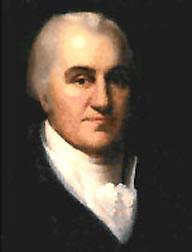
Joel Barlow (1754-1812)
The Founding Fathers Were NOT Christians or Secular Humanists: a Refutation of Steven Morris
by Lewis Loflin
Steven Morris complains that the Religious Right is rewriting American history to bolster a political agenda. Very true, but secular fundamentalists such as himself are doing the same thing. For secular fundies such as Morris, their low point came in 2004 with the re-election of George Bush.
In fascinating article from The Nation entitled In God's Country (11/6/2006) secular fundamentalists lamented,
...the nine in ten Americans who have said they've never doubted the existence of God. Or the eight in ten who believe the Lord works miracles. Or the same number who are certain they will be called to answer for their sins on Judgment Day. Or the tens of millions who attend church every week--more, in a typical seven-day span, than those who turn out for all sporting events combined...the idea that urbanization, scientific progress and rising living standards would gradually transform America into a secular society has long appealed to journalists and intellectuals. Talk about blind faith...
Secular arrogance in believing that anyone who believes in God is somehow a backward, country bumpkin is a big part of their elitist mentality. As the article continues,
...most of the Founders were Deists and Unitarians who rejected doctrines like the Incarnation. Thomas Jefferson dismissed the Trinity as "incomprehensible jargon." He and other Founders made no mention of God in the Constitution, and took pains not to establish an official church on US soil.
And yet, as various scholars have noted, disestablishment grew out of respect, not disdain, for religion, which, James Madison observed, "flourishes in greater purity without [rather] than with the aid of government." He was right...falling church membership stirred much excited talk about the so-called "death of God." Somebody forgot to inform the American people, an overwhelming majority of whom told pollsters they were believers...
The article destroys many other secular myths as well including:
- A large number of evangelical Christians don't live in the Bible Belt.
- Many of them aren't white. Many black and Latino voters aren't flocking to the GOP and vote Democrat. In fact, Protestants and Mormons are converting scores of Latinos and with the Catholic Church, are the largest supporters of illegal alien amnesty. Bush is in "lock-step" with the left on this.
- A majority of evangelicals actually hold an unfavorable view of people like Jerry Falwell and Pat Robertson. Most care more about jobs than gay marriage or abortion.
- The number of conservative Protestants who oppose abortion under all circumstances is a whopping 14 percent, less than the 22 percent who are consistently pro-choice.
- In 2004 election exit polls showed 22 percent of voters ranked "moral values" as their top priority. A comparable percentage of voters had listed values as their foremost concern in 1996 when Bill Clinton was re-elected.
- 82 percent of all Americans opposed Congress and the President's meddling in the Terri Schiavo case in 2004. Most Christians including Evangelicals support stem cell research.
- In 2004 the National Association of Evangelicals issued a statement affirming that the government "has an obligation to protect its citizens from the effects of environmental degradation." Others declared, "Our commitment to Jesus Christ compels us to solve the global warming crisis." Christians can also be "tree huggers."
- That both the civil rights and anti-slavery movements were Christian, not secular.
Leftist/liberal NPR reported on November 8, 2006 that many Evangelicals voted Democrat. Yet, the Republican Party is supposed to be in control of Jews and so-called "neo-cons," yet a CNN exit poll for November 7 showed the Jewish vote went 87% for Democrats.
And so on. This one statement is very profound with the secular left,
Some on the far left...(while)...happily disparaging Bible Belt Christians while giving a pass to Islamist forces in Palestine, Iraq and southern Lebanon. When it comes to the latter, care is taken to understand what draws people to Islam--the failure of secular ideologies...Might not some of the same factors be at play among born-again Christians in places like rural Alabama?
Treaty of Tripoly
"As the government of the United States of America is not in any sense founded on the Christian Religion, - as it has in itself no character of enmity against the laws, religion or tranquility of Musselmen, - and as the said States never have entered into any war or act of hostility against any Mahomitan nation, it is declared by the parties that no pretext arising from religious opinions shall ever produce an interruption of the harmony existing between the two countries."
In June 1797, the Senate unanimously ratified this treaty, which President John Adams immediately signed into law. While this was brought up by Daniel Pipes to illustrate we are not at war with Islam, but Islamo-fascism, Morris uses this as "proof" we are not a "Christian nation."
Pipes does name Morris for his article (see below), but Morris doesn't get it. It proved they had no hostility towards religion, not that they wanted faith excluded from the public. It is correct that God isn't mentioned in the Constitution, but I see no promotion of any particular religious system, including Secular Humanism.
It is very true that Freemasonry played a big part in the American Revolution, but Morris fails to note that one main requirement was a belief in God. He would never have been allowed to join.
In response to a reader request I looked into Deism and Freemasonry. Like all things influenced by the European Enlightenment they share many common values. America's most famous Freemason is also a Deist, George Washington. Not only did he allow Universalists to serve in his army, he had Jewish and Deists officers as well along with Enlightened Christians. In the Freemason lodges Protestants, Jews, Deists, Unitarians, and all who believed in God, liberty, etc. put aside their theological differences and joined together.
Because of the influence of the European Enlightenment and their Jewish/Christian traditions, these groups had many things in common. Half the signers of the Constitution were Freemasons as was Francis Scott Key who wrote our National Anthem and Frances Bellamy who wrote the Pledge of Allegiance. Not all Deists are Freemasons with Thomas Jefferson as one example. The claim that Freemasons are all Jews is also false.
Note my comments are in red below.
Excerpts from: he Founding Fathers Were Not Christians by Steven Morris, in Free Inquiry, Fall, 1995.
"The Christian right is trying to rewrite the history of the United States as part of its campaign to force its religion on others. They try to depict the founding fathers as pious Christians who wanted the United States to be a Christian nation, with laws that favored Christians and Christianity.
This is patently untrue.
The early presidents and patriots were generally
Deists or Unitarians, believing in some form of impersonal Providence but
rejecting the divinity of Jesus and the absurdities of the Old and New
testaments.
Thomas Paine was a pamphleteer whose manifestos encouraged the
faltering spirits of the country and aided materially in winning the war of
Independence:
I do not believe in the creed professed by the Jewish
church, by the Roman church, by the Greek church, by the Turkish church, by
the Protestant church, nor by any church that I know of...
Each of those
churches accuse the other of unbelief; and for my own part, I disbelieve them
all."
From:
The Age of Reason by Thomas
Paine, pp. 8,9 (Republished 1984, Prometheus Books, Buffalo, NY)
The only problem with the above statement as given is out of context. The Age of Reason was written to refute secular violence and terrorism of the French Revolution. But what did Paine really say? Here are some examples;
"I believe in one God, and no more; and I hope for happiness beyond this life."
"The moral duty of man consists in imitating the moral goodness and beneficence of God manifested in the creation toward all his creatures. That seeing, as we daily do, the goodness of God to all men, it is an example calling upon all men to practice the same toward each other."
"I trouble not myself about the manner of future existence. I content myself with believing, even to positive conviction, that the power that gave me existence is able to continue it in any form and manner he pleases, either with or without this body" (Age of Reason).
"I consider myself in the hands of my Creator, and that he will dispose of me after this life consistently with his justice and goodness" (Private Thoughts on a Future State)
"We believe in the existence of a God, and in the immortality of the soul."
"Were man impressed as fully and as strongly as he ought to be with the belief of a God, his moral life would be regulated by the force of that belief; he would stand in awe of God and of himself, and would not do the thing that could not be concealed from either. ... This is Deism."
George Washington, the first president of the United States, never declared himself a Christian according to contemporary reports or in any of his voluminous correspondence.
Washington Championed the cause of freedom from religious intolerance and compulsion. When John Murray (a universalist who denied the existence of hell) was invited to become an army chaplain, the other chaplains petitioned Washington for his dismissal.
Instead, Washington gave him the appointment. On his deathbed, Washington uttered no words of a religious nature and did not call for a clergyman to be in attendance.
From:
George Washington and Religion by Paul F.
Boller Jr., pp. 16, 87, 88, 108, 113, 121, 127 (1963, Southern Methodist
University Press, Dallas, TX)
While this is true, Washington's acceptance and tolerance of other beliefs is shown by his embracing Freemasonry. Unlike secular humanists, tolerance extended to all with Washington, not just tolerance of everything except Christianity. It should also be noted his wife and daughters were among the most pious of Christians.
John Adams, the country's second president, was drawn to the study of law but faced pressure from his father to become a clergyman. He wrote that he found among the lawyers 'noble and gallant achievements" but among the clergy, the "pretended sanctity of some absolute dunces". Late in life he wrote: "Twenty times in the course of my late reading, have I been upon the point of breaking out, "This would be the best of all possible worlds, if there were no religion in it!"
It was during Adam's administration that the Senate ratified the Treaty of Peace and Friendship, which states in Article XI that "the government of the United States of America is not in any sense founded on the Christian Religion."
From: The Character of John Adams by Peter Shaw, pp. 17 (1976, North Carolina Press, Chapel Hill, NC) Quoting a letter by JA to Charles Cushing Oct 19, 1756, and John Adams, A Biography in his Own Words, edited by James Peabody, p. 403 (1973, Newsweek, New York NY) Quoting letter by JA to Jefferson April 19, 1817, and in reference to the treaty, Thomas Jefferson, Passionate Pilgrim by Alf Mapp Jr., pp. 311 (1991, Madison Books, Lanham, MD) quoting letter by TJ to Dr. Benjamin Waterhouse, June, 1814.
Note that John Adams was a Unitarian and I have already addressed the issue of the Treaty of Tripoly. But what Morris fails to note is Adam's views of Christian basher and anti-Semitic bigots like Voltaire, whom secular fundamentalists like Morris present often as representing all of Deism.
Adams wrote of Voltaire, "How is it possible [that he] should represent the Hebrews in such a contemptible light? They are the most glorious nation that ever inhabited this Earth. The Romans and their Empire were but a Bauble in comparison of the Jews. They have given religion to three quarters of the Globe and have influenced the affairs of Mankind more, and more happily, than any other Nation ancient or modern."
Alexis de Tocqueville observed, "The Americans combine notions of Christianity and of liberty so intimately in their minds, that it is impossible to conceive the one without the other."
See John Adams embraces a Jewish homeland.
Thomas Jefferson, third president and author of the Declaration of
Independence, said:"I trust that there is not a young man now living in the
United States who will not die a Unitarian." He referred to the Revelation of
St. John as "the ravings of a maniac" and wrote:
The Christian
priesthood, finding the doctrines of Christ leveled to every understanding
and too plain to need explanation, saw, in the mysticisms of Plato, materials
with which they might build up an artificial system which might, from its
indistinctness, admit everlasting controversy, give employment for their
order, and introduce it to profit, power, and pre-eminence. The doctrines
which flowed from the lips of Jesus himself are within the comprehension of a
child; but thousands of volumes have not yet explained the Platonisms
engrafted on them: and for this obvious reason that nonsense can never be
explained."
From: Thomas Jefferson, an Intimate History by Fawn M. Brodie, p. 453 (1974, W.W) Norton and Co. Inc. New York, NY) Quoting a letter by TJ to Alexander Smyth Jan 17, 1825, and Thomas Jefferson, Passionate Pilgrim by Alf Mapp Jr., pp. 246 (1991, Madison Books, Lanham, MD) quoting letter by TJ to John Adams, July 5, 1814.
Thomas Jefferson held most clergy and organized religion in low regard not so much for theology, but for abuse of power and attacks on liberty. Jefferson identified himself as a Unitarian, not a Deist as such. But I have demonstrated that Deism as understood in America was drawn from Christianity, often a rejection of Calvinism. But what did Jefferson say on Jesus?
Jefferson was always reluctant to reveal his religious beliefs to the public...He was raised as an Anglican, but was influenced by English deists. "Question with boldness even the existence of God; because if there be one, he must more approve the homage of reason, than that of blindfolded fear." In Query XVII of in the Statute of Virginia for Religious Freedom: "The rights of conscience we never submitted, we could not submit. We are answerable for them to our God. The legitimate powers of government extend to such acts as are injurious to others. But it does me no injury for my neighbor to say there are twenty gods, or no god. It neither picks my pocket nor breaks my leg . . . . Reason and free inquiry are the only effectual agents against error."
His ideas are nowhere better expressed than in his compilations of extracts from the New Testament "The Philosophy of Jesus" (1804) and "The Life and Morals of Jesus" (1819-20?)...Jefferson believed in the existence of a Supreme Being who was the creator and sustainer of the universe and the ultimate ground of being, but this was not the triune deity of orthodox Christianity.
He also rejected the idea of the divinity of Christ, but as he writes to William Short on October 31, 1819, he was convinced that the fragmentary teachings of Jesus constituted the "outlines of a system of the most sublime morality which has ever fallen from the lips of man."
In correspondence, he sometimes expressed confidence that the whole country would be Unitarian, but he recognized the novelty of his own religious beliefs. On June 25, 1819, he wrote to Ezra Stiles, "I am of a sect by myself, as far as I know." Rebecca Bowman, Monticello Research Department, August 1997. Ref. http://www.monticello.org/reports/interests/religion.html
More notes on Jefferson below.
James Madison, fourth president and father of the Constitution, was
not religious in any conventional sense. "Religious bondage shackles and
debilitates the mind and unfits it for every noble enterprise."
"During
almost fifteen centuries has the legal establishment of Christianity been on
trial. What have been its fruits? More or less in all places, pride and
indolence in the Clergy, ignorance and servility in the laity, in both,
superstition, bigotry and persecution."
From:
The Madisons by Virginia Moore, P. 43 (1979, McGraw-Hill Co. New
York, NY) quoting a letter by JM to William Bradford April 1, 1774, and
James Madison, A Biography in his Own Words, edited by Joseph
Gardner, p. 93, (1974, Newsweek, New York, NY) Quoting Memorial and
Remonstrance against Religious Assessments by JM, June 1785.
Like his friend Jefferson he had a negative view of clerical abuse. He was likely influenced by English Deism like his friend Thomas Jefferson, which posits,
1. belief in the existence of a single supreme God
2. humanity's duty to revere God
3. linkage of worship with practical morality
4. God will forgive us if we repent and abandon our sins
5. good works will be rewarded (and punishment for evil) both in life and
after death.
Ethan Allen, whose capture of Fort Ticonderoga while commanding the
Green Mountain Boys helped inspire Congress and the country to pursue the War
of Independence, said, "That Jesus Christ was not God is evidence from his own
words." In the same book, Allen noted that he was generally "denominated a
Deist, the reality of which I never disputed, being conscious that I am no
Christian." When Allen married Fanny Buchanan, he stopped his own wedding
ceremony when the judge asked him if he promised "to live with Fanny Buchanan
agreeable to the laws of God." Allen refused to answer until the judge agreed
that the God referred to was the God of Nature, and the laws those "written in
the great book of nature."
From:
Religion of the
American Enlightenment by G. Adolph Koch, p. 40 (1968, Thomas Crowell
Co., New York, NY.) quoting preface and p. 352 of Reason, the Only Oracle
of Man and A Sense of History compiled by American Heritage
Press Inc., p. 103 (1985, American Heritage Press, Inc., New York, NY.)
Allen never had anything to with the Constitution or held any public office. John Jay was his polar opposite did. Also according to Wikipedia, he just wasn't a big part of the American Revolution. Ref. http://en.wikipedia.org/wiki/Ethan_Allen.
Benjamin Franklin, delegate to the Continental Congress and the
Constitutional Convention, said:
As to Jesus of Nazareth, my Opinion
of whom you particularly desire, I think the System of Morals and his
Religion...has received various corrupting Changes, and I have, with most of
the present dissenters in England, some doubts as to his Divinity; tho' it is
a question I do not dogmatize upon, having never studied it, and think it
needless to busy myself with it now, when I expect soon an opportunity of
knowing the Truth with less trouble." He died a month later, and
historians consider him, like so many great Americans of his time, to be a
Deist, not a Christian.
From:
Benjamin Franklin, A
Biography in his Own Words, edited by Thomas Fleming, p. 404, (1972,
Newsweek, New York, NY) quoting letter by BF to Exra Stiles March 9,
1970.
But as a secular humanist or atheist, Morris doesn't understand what Deism was as far as the Nation's Founders are concerned. There are a couple of versions of a religious creed that appears both in Ben's autobiography and, later in his life, in a letter to Ezra Stiles. Below are the words from his autobiography:
[I believe] That there is one God, who made all things. That he governs the world by his providence. That he ought to be worshiped by adoration, prayer, and thanksgiving. But that the most acceptable service of God is doing good to man. That the soul is immortal. And that God will certainly reward virtue and punish vice, either here or hereafter.
This s more traditional Deism, hardly the belief "God made the universe and went away" nonsense from secular fundamentalists like Morris. On June 28, 1787, Franklin made a formal motion for prayers at the Constitutional Convention. The text of the motion itself reads:
I therefore beg leave to move, That henceforth Prayers, imploring the Assistance of Heaven and its Blessing on our Deliberations, be held in this Assembly every morning before we proceed to Business, and that one or more of the Clergy of this city be requested to officiate in that Service.
This text is from Albert Henry Smyth's 1906 edition of The Writings of Benjamin Franklin, Collected and Edited with a Life and Introduction, vol. IX, page 601. Franklin preceded the actual motion with a page and a half of explanation supporting the idea. After the motion, there is a footnote by the editor that reads: "Note by Franklin.--'The convention, except for three or four persons, thought prayers unnecessary.'" None of this suggest hostility to Christianity or demands that all public displays of faith be banned.
The words "In God We Trust" were not consistently on all U.S. currency until 1956, during the McCarthy witch hunts.
In 1796, U.S. Vowed Friendliness With Islam
by Daniel Pipes
New York Sun
November 7, 2006
Has the United States ever engaged in a crusade against Islam? No, never. And, what's more, one of the country's earliest diplomatic documents rejects this very idea.
Exactly 210 years ago this week, toward the end of George Washington's second presidential administration, a document was signed with the first of two Barbary Pirate states. Awkwardly titled the "Treaty of Peace and Friendship, signed at Tripoli November 4, 1796 (3 Ramada I, A. H. 1211), and at Algiers January 3, 1797 (4 Rajab, A. H. 1211)," it contains an extraordinary statement of peaceful intent toward Islam.
The agreement's 11th article (out of twelve) reads: As the government of the United States of America is not in any sense founded on the Christian Religion, - as it has in itself no character of enmity against the laws, religion or tranquility of Musselmen, - and as the said States never have entered into any war or act of hostility against any Mahomitan nation, it is declared by the parties that no pretext arising from religious opinions shall ever produce an interruption of the harmony existing between the two countries."
In June 1797, the Senate unanimously ratified this treaty, which President John Adams immediately signed into law, making it an authoritative expression of American policy.
In 2006, as voices increasingly present the "war on terror" as tantamount to a war on Islam or Muslims, it bears notice that several of the Founding Fathers publicly declared they had no enmity "against the laws, religion or tranquility" of Muslims.
This antique treaty implicitly supports my argument that the United States is not fighting Islam the religion but radical Islam, a totalitarian ideology that did not even exist in 1796.
Beyond shaping relations with Muslims, the statement that "the government of the United States of America is not in any sense founded on the Christian Religion" has for 210 years been used as a proof text by those who argue that, in the words of a 1995 article by Steven Morris, "The Founding Fathers Were Not Christians."
But a curious story lies behind the remarkable 11th article.
The official text of the signed treaty was in Arabic, not English; the English wording quoted above was provided by the famed diplomat who negotiated it, Joel Barlow (1754-1812), then the American consul-general in Algiers. The U.S. government has always treated his translation as its official text, reprinting it countless times.
There are just two problems with it.
First, as noted by David Hunter Miller (1875-1961), an expert on American treaties, "the Barlow translation is at best a poor attempt at a paraphrase or summary of the sense of the Arabic." Second, the great Dutch orientalist Christiaan Snouck Hurgronje (1857-1936), reviewed the Arabic text in 1930, retranslated it, and found no 11th article. "The eleventh article of the Barlow translation has no equivalent whatever in the Arabic," he wrote. Rather, the Arabic text at this spot reprints a grandiloquent letter from the pasha of Algiers to the pasha of Tripoli.
Snouck Hurgronje dismisses this letter as "nonsensical." It "gives notice of the treaty of peace concluded with the Americans and recommends its observation. Three fourths of the letter consists of an introduction, drawn up by a stupid secretary who just knew a certain number of bombastic words and expressions occurring in solemn documents, but entirely failed to catch their real meaning."
These many years later, how such a major discrepancy came to be is cloaked in obscurity and it "seemingly must remain so," Hunter Miller wrote in 1931. "Nothing in the diplomatic correspondence of the time throws any light whatever on the point."
But the textual anomaly does have symbolic significance. For 210 long years, the American government has bound itself to a friendly attitude toward Islam, without Muslims having signed on to reciprocate, or without their even being aware of this promise. The seeming agreement by both parties not to let any "pretext arising from religious opinions" to interrupt harmonious relations, it turns out, is a purely unilateral American commitment.
And this one-sided legacy continues to the present. The Bush administration responded to acts of unprovoked Muslim aggression not with hostility toward Islam but with offers of financial aid and attempts to build democracy in the Muslim world.
From www.danielpipes.org. Original article available at: http://www.danielpipes.org/article/4099.

- Premillennialism and John Nelson Darby
- Comments From a Former Fundamentalist
- Who is Nature's God?
- The Founding Fathers Were NOT Christians or Secular Humanists
- Saul of Tarsus, Mithraic Cults, and Christ's Blood
- In 1796, U.S. Vowed Friendliness With Islam
- The Jesus Tapes
- Sullivan County, Tennessee Religious Wars
- The Christian Reich in Sullivan County, Tennessee
- Jerry Falwell, the Antichrist, attacks Jews
- Children Pay the Cost of Superstition
- Bob Jones University Responds to racism and anti-Catholic accusations
- Fundamentalist Foolishness, Bob Jones, George Bush
- Roman Catholicism and Biblical Christianity
- Bob Jones at Home in Sullivan County Tennessee
- Tennessee Strip Bar Wars
- Washington County Adult Entertainment Board discusses definition of 'adult'
- Washington County adult entertainment board rejects 19 applicants
- Nuisance law, informants aid prostitution crackdown
- Sullivan County, Tennessee Strip Bars Wars Update for 2002
- Comments From a Former Fundamentalist
- Strip Club regulations upheld by Tennessee Court of Appeals; Sullivan law remains in force
- Judge: Nashville can't enforce adult club rule
- Sullivan County Tennessee Cathouse
- Sullivan County Exposed