Virginia Crime Roundup 2015
- Also on Virginia Crime:
- Machete Wielding Hispanic Shot Dead
- Virginia Crime Roundup 2012
- Lakeem Scott and Press Incitement to Murder
Summary Virginia crime for 2015: Blacks commit over half of all the violent crime in Virginia including the majority of murders, three-fourths of the robberies, over half the assaults, and almost half the burglaries. Virginia doesn't have an offender category for Hispanics that are counted as white inflating the white crime rates. Asians score best of all with half or less of the white crime rates. I combined Asian and American Indian together.
I revile the terms Hispanic and white Hispanic - white Hispanics are white and should be counted as such. Blacks from Haiti and the Caribbean should be counted as blacks, while those from Mexico, Central America, etc. that are primarily Indian extraction should be counted as American Indians. The last time I checked Spain was in Europe and Europeans are white even in Spain.
El Salvadorans, Costa Ricans, etc. whose criminal gangs like MS-13 have overrun large parts of the Commonwealth of Virginia are American Indians and should not be counted as white.
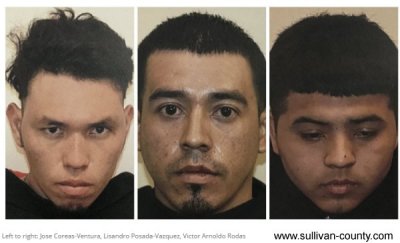
Typical is the three Central American MS-13 savages that killed a 17-year-old over bad drug deals distorts crime statistics in this state. The victim according to my sources had a hand cut off and nearly beheaded, will be counted as white offenders. To quote www.daileycaller.com 04/03/2017:
A 17-year-old boy's body was mutilated by MS-13 gang members, the boy's uncle ... his nephew’s body had been savaged by his murderers. "His hands were cut off, his throat was cut, his tongue was pulled into his throat, he was stabbed 16 times, ran over 3 times...How do you do that to a child?...These are monsters."
The Roanoke Times reports, police charged three illegal immigrants with Wood’s death — 21-year-old Jose Corea-Ventura, 19-year-old Victor Arnoldo Rodas, and 24-year-old Lisandro Posada-Vazquez. The men were determined to be illegal by the Bedford County Sheriff’s Office, detained, and subsequently arrested by U.S. Immigration and Customs Enforcement.
Corea-Ventura was arrested in connection to a separate gang-related murder in Montgomery County, Maryland, where a male victim was stabbed 40 times with a knife. Evidently, Corea-Ventura had been hiding from authorities since July, and ended up in Bedford County, Virginia.
All three were in the country illegally. Virginia must begin to add a Hispanic and a non-citizen offender category.
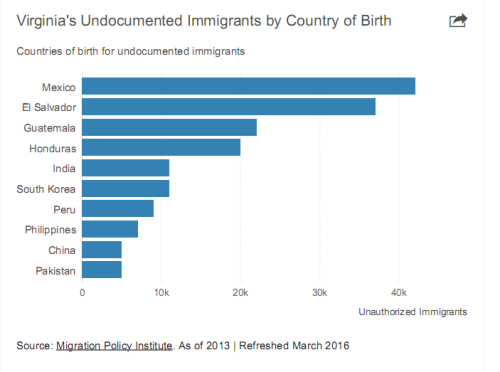
Newsmax estimated 210,000 illegal aliens in 2015, but I think it's much higher. Illegal aliens in Virginia are heavily loaded towards Central Americans and Mexicans, but large numbers of Muslim and Chinese illegals. Considering Islamic violence and the presence of large numbers of illegal alien Chinese in Northern Virginia should raise security concerns.
Crime Rates by Race
Study population 2015 was 8,383,000.
VA. demographics 2016 white non-Hispanic 62.7%; Black 19.7%; Hispanic 9%; Asian 6.5%; Indian .5%. Should be close enough.
White 5,256,000; Black 1,651,451; Hispanic 754,470; Asian 544,895.
White is understood to include Hispanics = 5,256,000 + 754,470 = 6,010,470.
Ref. 2008 BJS Hispanics commit 1.5 to 2 times the crime rates of whites. Hispanic is a stupid designation as Hispanic whites should be counted as white, Hispanic blacks should be counted as black, and those Indians or mixed Indian should be counted as American Indian.
Formula: Number of crimes / population * 100,000.
Ref. Virginia State Police crime stats 2015.
Murder
Murder victims were 382 in 2015 up from 316 from 2012.
See Crime by Race in Virginia 2012
State wide 4.56 per 100,000 in 2015 up from 3.86 in 2012 and below the peak 5.33 in 2007.
Offenders 2015 White/Hispanic 112; Black 243; Asian/Indian 5; Unknown 33. Total offenders 398. Blacks were 61% of offenders.
Per 100,000 white 1.86; Black 14.71; Asian 0.92
Victims 2015 White 134; Black 238; Asian/Indian 4; Blacks were 63% of the victims.
Blacks at 19.7% of the Virginia population were offenders at 59% in 2015 down from 61% in 2012 almost unchanged.
Compared to whites who make up the majority of poor people in Virginia blacks are 8 times more likely to commit murder.
Conclusion: murder is mainly an intra-racial crime with blacks being vastly over represented as offenders and victims.
Sex Offences
Forcible Sex Offenses victims 5,097, 4,787 offenses, victims 60.8 per 100,000
White/Hispanic offender 2748; Black offender 1683; Unknown offender 209; Asian/Indian 66
Per 100,000 white 45.72; Black 102; Asian 12.1
Blacks at 19.7% of the Virginia population committed 35% of violent sexual assaults and twice as likely as whites to commit sexual assault.
Victims: White 3481; Black 1402; Asian/Indian 67; Unknown 140.
There are 733 more white/Hispanic victims than white/Hispanic offenders; there are 281 more Black offenders than Black victims. Without better data one must conclude interracial rapes were mostly black on white/Hispanic, but mixing in Hispanics as whites distorts the white victim and offender data. Asian victims seem to be victims of other Asians.
Robbery
Robbery 4,459 reported robberies and attempted robberies in 2015.
Offender by race: White 1,142; Black 3,799; Asian/Indian 12; Unknown 149.
Per 100,000 white 19; Black 230; Asian 2.2.
Blacks at 19.7% of the Virginia population were 74.5% of the offenders in 2015. They are 12 times more likely to commit robbery than whites/Hispanics.
Victims: White 2674; Black 2252; Asian/Indian 252; Unknown 99.
Robbery is mostly a Black crime. Asians and Whites seem a large target.
Assault
Assault 9,318 victims rate of 111.15 per 100,000; 7,864 offences.
Offenders White 3713; Black 4269; Asian/Indian 74; Unknown 113.
Per 100,000 white 61.8; Black 258.5; Asian 13.6.
Blacks commit at 19.7% of the population 54.3% of assaults. They are 4.2 times as likely to commit assault than whites.
Kidnapping 1,299 incident and 1,484 victims. No racial demographics supplied.
Burglary
Burglary 21,068 offenses.
Offenders White 4990; Black 4659; Asian/Indian 60; Unknown 271.
Per 100,000 white 83; Black 282; Asian 11
Ratios Black vs. white is 3.4 to 1; white vs. Asian is 7.4 to 1.
Blacks at 19.7% of the population were 47.7% of the offenders. They are 3.4 times more likely to commit burglaries than whites.
Larceny 128,930 offenses reported. No racial demographics were supplied.
Hate Crimes
There were 155 hate crimes reported. Of the anti-religion hate crimes 8 Jewish, 4 Protestant, 7 Muslim. These are very rare regardless of press and political hysteria.
White 75, Black 30, Unknown 1
Per 100,000 white 1.25; Black 1.8; 73 of 155 were physical assaults. Blacks commit more hate crimes than whites. The whole hate crime category needs to be eliminated and are more political than anything else.
Arson
Arson offenders white 310; Black 207; Asian/Indian 4; Unknown 17. Total 538. Blacks at 19.7% of the population were arrested for 38.5% of arson offences.
Per 100,000 white 5.16; Black 12.5; Asian 0.73
Violent Crime includes murder, manslaughter, aggravated assault, sex offenses, robbery - total 18,348
Offenders White 7715; Black 9961; Asian/Indian 161; Unknown 478.
Per 100,000 white 128.4; Blacks 603; Asian 29.55.
Ratios: Black vs. White is 1 to 4.7; white vs. Asian is 4.35 to 1
Blacks alone at 19.7% of the population make up 54.3% of all violent crime offenders in Virginia - more than the rest of the state combined including unknowns. They are likely to commit 4.7 times the violent crime than whites do.
- Crime by Race in Virginia 2012
- Virginia Crime by Race 2015
- Liberals Ignore Minority Violence for Political Gain
- Oikophobia the Liberal Mental Disorder
- Leftism, Islamist' Alliance of Extremism
- Why Crime Rates Have Little to do with Poverty
- St. Louis Black Youth Gunshot Death Rate
- Exporting Black Violence to Ferguson Missouri
- Crime Rates by Race in Missouri
- Government Sanctioned Racism
- Black Crime in Connecticut
- New Jersey Crime Product of Poverty, Class Warfare, Mass Immigration
- Indoctrination in Chicago Schools
- Liberals Fail Seattle Public Schools
- Why Progressives Became Racists
- Progressives Are Not Liberals!
- It's Single Motherhood Not Racism
- Exploring Jonah Goldberg's Book 'Liberal Fascism'
- Marxism is a Pagan Religious Cult
- DACA Poster Child Rapes 9-Year-Old in Virginia
- Illegal Immigration Plagues Tennessee
- Machete Wielding Hispanic Shot Dead
- Romantic Notions of Mexicans Can Mean Trouble
- Drunk Illegal Alien Driver Pleads Guilty Gatlinburg, Tennessee
- Lies Surround Racism Claims in Public Schools
- IQ Versus Outcome Not So Simple
- Why Many People Shouldn't Get a 4-Year Degree
- Intelligence Predicts Economic Social Outcome
- Christina Eilman Rape Costs Chicago Police Millions
- 12-Year-Old Emily Haddock Murder
- Emily Haddock killers Get Plea Bargain
- 15-Year-Old White Girl Gang Raped at California School
- Fear of Islam is not Islamophobia
- Europeans Victims of (Muslim) Colonialism
- Deist Examination of Islamic Trinity
- Mohammed the Man as Islamic Ideology
- Why Muslims Can't Build a Lightbulb
- Bacon is not a Hate Crime
- Press Tries to Cover Up Muslim Violence
- Twenty-Year Plan Islam Targets America
- Mythical Prophet of Early Islam
- Judeo-Christian Violence vs. Islamic Violence
- When Christianity Pushed Back Muslim Attacks
- Islam the Demise of Classical Civilization
» Archive 1 » Archive 2 » Archive 3
» Archive 4 » Archive 5 » Archive 6
» Archive 7 » Archive 8 » Archive 9