Grundy, Virginia and the $200 Million Bridge to Nowhere

by Lewis Loflin

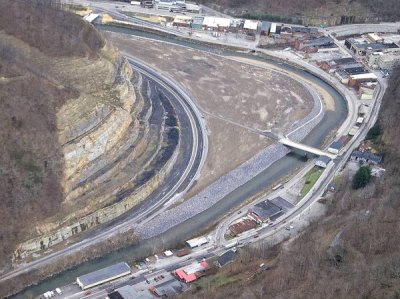
(Above) From the U.S. Army Corps of Engineers (a government agency). A view of Grundy, circa 2005. The flood control project is on the left.

Quoting a Grundy, Virginia resident, nothing ever changes. And he was right, questionable pork-barrel government projects in Grundy have gone whole hog. After five years of work (as of 2007) to clear a 13-acre site for a new downtown, they still hope to build a new town. At least that's what town officials hoped, but it didn't turn out that way. After moving 2 million cubic yards of rock/dirt and costing as much as $200 million, we get a Wal-Mart. with a population of about 1100 in 2000, that's $182,000 per resident.
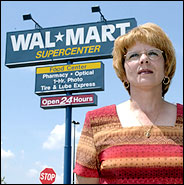
This super-duper Wal-Mart Supercenter is "unique" being built atop a parking garage. The idea was to save space at the 10 or 13 acre site, the press can't seem to decide. Commonwealth Development Co., a Knoxville developer that is supposed to invest $20 million in the super strip mall, had to have a way to cross the river to start construction. Public officials built them a $1.8 million bridge. As of August 2007 the bridge is only open to contractors. U.S. Rep. Rick Boucher, D-9th. Boucher helped pork-out $76 million in federal funding for so-called flood control, while VDOT porked-out $33 million to purchase the mostly vacant buildings and property for the road project that will cost another $25 million.

According to news reports, (Washington Post) the former business owners pocketed the hefty taxpayer loot they got for the government tearing their mostly closed businesses. They have no plans at all to reopen and this has generated outrage among many Virginia residents. As usual they are claiming hundreds of new jobs to the area. To quote, "It's going to be a big improvement in convenience. Right now the stores are located in different places. There is not very much parking. The closest Wal-mart right now is 40 miles away." This was according to a student at the local law school. That too is another taxpayer creation being bottle-fed an endless diet of government economic development money. I hope he plans to work at Wal-Mart. They also put in a pharmacy school.

See APPALACHIAN SCHOOL OF LAW

Appalachian School of Law shooting

This should be notable on outcome. Virginia Tech banned students, even with permits to have guns on campus. Here that stupid rule didn't exit. Instead of 32 dead, we got three.

Ref. Wikipedia On January 16, 2002, 43-year-old Peter Odighizuwa, a Nigerian former student at the Appalachian School of Law, arrived on the campus. While numerous reports stated that Odighizuwa had flunked out of school or had been suspended, Jeremy Davis, former dean and professor of law at the school, later said that Odighizuwa had withdrawn voluntarily due to poor academic performance. He was there on a diversity quota, and wasn't qualified to do the work. (He is from Nigeria.)

Odighizuwa first discussed his academic problems with professor Dale Rubin, where he reportedly told Rubin to pray for him. Odighizuwa then walked to the offices of Dean Anthony Sutin and Professor Thomas Blackwell, where he opened fire with a .380 ACP semi-automatic handgun. According to a county coroner, powder burns indicated that both victims were shot at point blank range. Also killed along with the two faculty members was a student, Angela Denise Dales, age 33. Three other people were wounded. When Odighizuwa exited the building where the shooting took place, he was approached by two students with personal firearms and one unarmed student. There are two versions of the events that transpired at that moment, one by Bridges and one by Besen.

According to Bridges, at the first sound of gunfire, fellow students Tracy Bridges and Mikael Gross, unbeknownst to each other, ran to their vehicles to fetch their personally-owned firearms. Gross, a police officer with the Grifton Police Department in his home state of North Carolina, retrieved a 9 mm pistol and body armor. Bridges, a county sheriff's deputy from Asheville, N.C., pulled his .357 Magnum pistol from beneath the driver's seat of his Chevy Tahoe. As Bridges later told the Richmond Times Dispatch, he was prepared to shoot to kill. Bridges and Gross approached Odighizuwa from different angles, with Bridges yelling at Odighizuwa to drop his gun. Odighizuwa then dropped his firearm and was subdued by several other unarmed students, including Ted Besen and Todd Ross.

According to Besen, before Odighizuwa saw Bridges and Gross with their weapons, Odighizuwa set down his gun and raised his arms like he was mocking people. Besen then charged, got into a scuffle with Odighizuwa, and knocked him to the ground. Bridges and Gross then arrived with their guns once Odighizuwa was tackled.

Once Odighizuwa was securely held down, Gross went back to his vehicle and retrieved handcuffs to detain Odighizuwa until police could arrive. Police reports later noted that two empty eight round magazines designed for Odighizuwa’s handgun were recovered. At trial, Odighizuwa was found mentally competent and pleaded guilty to the murders to avoid the death penalty. Odighizuwa was sentenced to multiple life terms in prison.

Phony Jobs

Update August 2007. Here is another example of how government plays silly games with employment numbers. Economic developers made a big deal about opening a new processing center for employment claims at an industrial park in Buchanan County, Virginia. This is the site of several failed businesses lured in with tax dollars. These "new jobs" like most government jobs pay far more than the low wage private sector jobs they brought in before and aren't as likely to close down. Then we get this, they are firing other workers in Bristol, Virginia, etc. These are not new jobs, just more jobs relocating a few miles down the road. Guess they need something in those costly taxpayer funded industrial parks. The Virginia Employment Commission planned to lay off most hourly, part-time staff, the plan calls for eliminating more than 50 jobs at seven field offices across the area. (40 percent cut in staff.) Funding for the Employment Commission comes from the federal government based on the number of unemployment insurance claims filed in the state. Claim filings have dropped by about 40 percent in 2005. The Employment Commission to handle a $20 million budget cut from $74 million this year to $54 in 2006.

Also see The Truth About Unemployment


1984 flood in Grundy, Virginia

Material below taken from the U.S. Army Corps of Engineers' Grundy Flood Control Project Web site at http://www.lrh.usace.army.mil/pa/HotTopics/Grundy.htm

HISTORY/BACKGROUND

Legislation
As a result of the devastating flooding that occurred in 1977, Congress directed the Corps of Engineers in the 1981 Water and Energy Appropriations Act to evaluate the flooding problems in three river basins within the Appalachian region and target flood protection specifically for five major communities within those basins. The Town of Grundy, Virginia, was one of the five named communities.

Structural Alternatives
From the early 1980’s when the Corps first started evaluating the flooding problem in Grundy until the mid 1980’s, the Huntington District worked with the mayor and the town council in evaluating an array of structural alternatives that might address the flooding problem. By structural alternatives we mean those measures such as dams and channel improvements that prevent floodwaters from reaching existing residences and businesses prone to flooding conditions. The alternatives evaluated included a reservoir upstream of the town, floodwalls, an open cut channel alternative similar to the Pikeville, Kentucky, Cutoff Project as well as a diversion tunnel designed to provide protection primarily to the Central Business District (CBD) area and a wide array of channel improvement alternatives of various lengths and widths.

After more than six years of intense study, it was determined that for several reasons a structural solution to the flooding problem in Grundy was not a feasible alternative. 

  • No structural alternative identified provided total protection to the town from a flood equal to the 1977 flood. Each alternative evaluated required the inclusion of extensive nonstructural measures (see below for description of nonstructural alternatives) to provide total protection mandated by the legislation. 
  • Each of the alternatives studied imposed significant construction impacts on the very development that it was designed to protect. 
  • Each of the structural alternatives imposed significant environmental impacts in the area thereby raising serious concerns from the environmental community. 
  • It was determined that the structural alternatives when complemented with the appropriate nonstructural measures required to provide April 1977 level of protection were not affordable to either the federal government or to the town of Grundy. Before 1986, the Corps' flood protection projects received full federal funding. However, with the Water Resources Development Act of 1986, project cost sharing became law. Projects of these types required a non-federal cost sharing sponsor to provide a minimum of 25% to a maximum of 50% of total project cost including a required 5% cash contribution. 


Nonstructural Alternatives

Recognizing the importance of finding an effective approach to flood protection, the Corps and the town began evaluating nonstructural alternatives. Nonstructural alternatives focus on efforts and measures to reduce flood damages in an area by addressing the development in the floodplain. Alternatives include such measures as floodplain zoning, participating in the National Flood Insurance Program, developing and implementing flood warning systems and emergency evacuation plans and floodproofing individual structures as well as removing structures from the extreme flood hazard areas. To assist the Corps in developing these plans, Grundy appointed a task force comprised of a cross-section of the business community who would work with the Corps in formulating these plans.  The task force leader was the late Mr. Ron King, a prominent Grundy attorney. The Corps and the Grundy task force first met in July 1989.

During the early stages of planning, it was obvious that implementing a voluntary program of floodproofing and floodplain evacuation such as was underway in several locations in the Tug Fork Basin was feasible for those residences and businesses along the Levisa Fork upstream and downstream of the downtown business district and along Slate Creek. However, it was equally obvious that these alternatives could not be applied to the downtown buildings given the type of structures, their age and common wall construction and the depth of flooding experienced during the 1977 flood. It was apparent that a unique solution not previously used by the Corps was the answer --  relocating the business district to an area higher than the 1977 flood, or floodsafe redevelopment.

The Corps and task force initially developed two plans that incorporated floodsafe redevelopment for the business district.  These plans required the floodsafe reconstruction of the downtown area on floodsafe platforms in essentially the same area in which they currently existed. These plans required careful phasing of demolition and reconstruction in place to minimize the impact on the existing businesses. After carefully reviewing these plans,  the Corps and the task force determined that while much less costly than the structural alternatives considered previously, implementation of such a plan in the downtown area was simply not workable given the timing and sequencing required to remove the old structures and replace them with new floodsafe structures without severely impacting businesses and day-to-day life. The task force recommended redevelopment in an area adjacent to the downtown area which was then occupied by the P. V. Dennis Elementary and the Grundy Jr. High School.

The Corps went back to the drawing board and essentially reevaluated the first two plans incorporating the use of the school site for redevelopment as opposed to rebuilding in place on raised floodsafe platforms. The task force found these two alternative plans to be much more acceptable and offered the opportunity for a smoother transition from the old floodprone development to the new floodsafe redevelopment. The mayor and town council (at the recommendation of the task force) selected Plan 3 as the preferred plan. Plan 3 consisted of the following components:

    -- Voluntary floodproofing/floodplain evacuation for the Slate Creek area and those areas along the Levisa Fork upstream and downstream of the downtown business district.

    -- Acquisition of structures along Riverside Drive.

    -- Construction of a ringwall to protect the side of town in the vicinity of the courthouse.

    -- Floodsafe redevelopment at the site of the P. V. Dennis Elementary and the Grundy Jr. High School.

    -- Relocation of the two public schools to a floodsafe site.

    -- Relocation of the fire station.

    -- Floodplain zoning.

    -- Participation in the National Flood Insurance Program.

    -- Development of a flood warning and emergency evacuation plan.

Although the town preferred Plan 3, there was one insurmountable obstacle standing in the way of its implementation – the cost-share required by the Water Resources Development Act of 1986. This law required at least 25% cost share requirement by a non-federal sponsor, which equated to nearly $25 million for this project. The required non-federal share was not affordable to the town.

Plan 3A
During the same timeframe that the Corps and the town were evaluating flood control plans, the Virginia Department of Transportation (VDOT) was evaluating alternative alignments for improvement of U. S. 460 in the Grundy area. Prior to this point the Corps and VDOT compared plans and status of efforts, but no connection was made to the potential compatibility of the two projects since the Corps was pursuing a flood control plan for the town, and VDOT had an approved by-pass around the town for improvement of U. S. 460. However, at the encouragement of then State Delegate Don McGlothlin and U.S. Congressman Rick Boucher, the Corps and VDOT explored potential benefits that might be derived from a joint project. After numerous coordination meetings between the Corps, VDOT and the task force, the potential was evident that the Corps and VDOT could save money by combining projects and at the same time meet the non-federal cost sharing requirements of the town at no cost to the town.

The joint project consisted of the Corps' flood control project combined with VDOT’s improvement of U. S. 460 through the town rather than bypassing the town. The joint project reduced costs for both the Corps and VDOT.  By VDOT receiving credit for the acquisition of lands needed for highway improvement common to the joint flood control project, the non-federal cost sharing requirement of 25% of total project costs would be met by VDOT. This plan was known as plan 3A.

Plan 3A was authorized for implementation by Congress in Water Resources Development Act of 1996 at the request of Congressman Boucher and concurrence by the town.

Subsequent to the authorization of Plan 3A for implementation, the task force, the Corps and VDOT have worked to fine tune this plan to minimize the impact of the improvement of U. S. 460 through Grundy on the existing town. The Corps also had to identify an alternative floodsafe redevelopment site, since the previously selected site is the home for the Appalachian School of Law.  As a result, the Corps with the assistance of the task force identified the depot site as a suitable alternative floodsafe redevelopment site.

Homepage Terrorism Guestbook E-Mail
Article List 1 Christianity Deism Page Article List 2

Offsite Links

http://www.sullivan-county.com/

Posted 7/16/07